Introduction
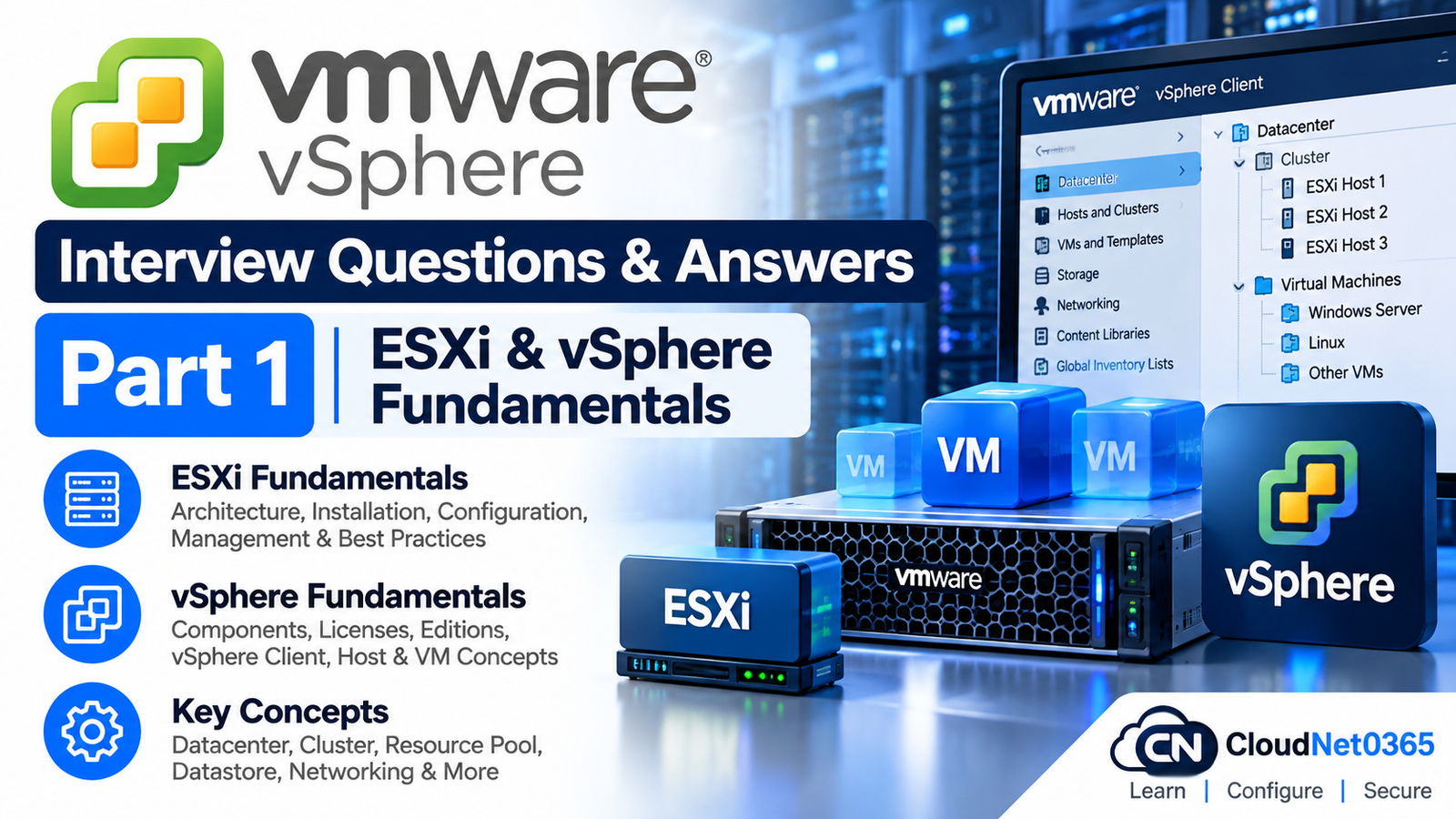
VMware vSphere is one of the most widely used virtualization platforms in enterprise data centers. For a System Administrator or System Engineer, understanding ESXi, virtual machines, VMkernel networking, CPU and memory management, VMware Tools, snapshots, templates and basic troubleshooting is essential.
This Day 4 Part 1 focuses on the fundamentals of VMware vSphere and ESXi that are commonly tested in technical interviews.
The questions progress from fundamental concepts to practical administration and troubleshooting scenarios.
VMware vSphere Interview Questions – Day 4 Part 1
1. What is VMware vSphere?
Answer:
VMware vSphere is VMware’s enterprise virtualization platform used to create, run and manage virtual machines and virtualized infrastructure.
The core components include:
- ESXi – The hypervisor that runs virtual machines.
- vCenter Server – Centralized management platform for ESXi hosts and virtual infrastructure.
- vSphere Client – Management interface used to administer the environment.
- vSphere HA – Provides VM availability during host failures.
- vSphere DRS – Helps balance workloads across hosts in a cluster.
- vMotion – Allows supported running VMs to be migrated between hosts.
2. What is ESXi?
Answer:
ESXi is VMware’s bare-metal hypervisor. It is installed directly on a physical server and allows multiple virtual machines to run on the same physical hardware.
ESXi provides virtualization of resources such as:
- CPU
- Memory
- Storage
- Network
- Virtual devices
Unlike a traditional operating system-based virtualization model, ESXi runs directly on the physical hardware.
3. What is a Type 1 hypervisor?
Answer:
A Type 1 hypervisor, also called a bare-metal hypervisor, runs directly on physical hardware rather than on top of a conventional host operating system.
Examples include:
- VMware ESXi
- Microsoft Hyper-V
- Xen
ESXi is therefore classified as a Type 1 hypervisor.
4. What is the difference between a Type 1 and Type 2 hypervisor?
Answer:
A Type 1 hypervisor runs directly on physical hardware.
A Type 2 hypervisor runs as an application on top of a host operating system.
Example:
Type 1:

Physical Hardware
       ↓
     ESXi
       ↓
Virtual Machines
Type 2:
Physical Hardware
↓
Host Operating System
↓
VMware Workstation
↓
Virtual MachinesVMware ESXi is Type 1, while VMware Workstation is Type 2.
5. What is a virtual machine?
Answer:
A virtual machine (VM) is a software-defined computer that runs on a physical host through a hypervisor.
A VM can have virtual:
- CPU
- Memory
- Network adapters
- Storage controllers
- Disks
- CD/DVD devices
- Other virtual hardware
The guest operating system runs inside the VM as though it were running on a physical computer.
6. What is the difference between a physical server and a virtual machine?
Answer:
A physical server uses dedicated physical hardware, while a virtual machine uses virtualized hardware provided by the hypervisor.
For example:
| Physical Server | Virtual Machine |
|---|---|
| Physical CPU | vCPU |
| Physical RAM | vRAM |
| Physical NIC | vNIC |
| Physical disk/storage | Virtual disk |
| Physical hardware | Virtual hardware |
Multiple VMs can share the resources of a physical ESXi host.
7. What is a VMkernel?
Answer:
The VMkernel is the core operating-system component of ESXi that manages access to physical hardware and provides services required by the virtualization platform.
VMkernel also provides specialized networking functions through VMkernel adapters, such as:
- Management traffic
- vMotion
- IP-based storage traffic
- vSAN traffic
- Fault Tolerance traffic
The exact services available depend on the vSphere configuration and version.
8. What is a VMkernel adapter?
Answer:
A VMkernel adapter is a logical network interface on an ESXi host used by the VMkernel for specific types of infrastructure traffic.
Common examples include:
- Management
- vMotion
- iSCSI
- vSAN
- Provisioning
- Fault Tolerance
A VMkernel adapter is different from a VM’s virtual network adapter because it is used by the ESXi host rather than by the guest operating system.
9. What is the difference between a VMkernel adapter and a VM network adapter?
Answer:
A VMkernel adapter is used by the ESXi host for infrastructure services.
A VM network adapter, such as a virtual VMXNET3 adapter, is presented to a guest operating system and provides network connectivity to the VM.
In simple terms:
ESXi Host
   │
   └── VMkernel Adapter
          ↓
      ESXi services

Virtual Machine
   │
   └── vNIC
          ↓
      Guest OS networking
10. What is a virtual switch in VMware?
Answer:
A virtual switch provides network connectivity between virtual machines, VMkernel interfaces and physical network adapters.
VMware provides two primary switch types:
- vSphere Standard Switch (VSS)
- vSphere Distributed Switch (VDS)
A standard switch is configured independently on each ESXi host, while a distributed switch provides centralized switch configuration across multiple hosts.
11. What is a port group?
Answer:
A port group is a logical grouping of network ports on a VMware virtual switch.
Port groups can be used to define network configuration such as:
- VLAN configuration
- Security policies
- Traffic shaping
- NIC teaming/failover policies
A VM’s virtual network adapter is normally connected to a port group.
12. What is a datastore?
Answer:
A datastore is a logical storage container used by vSphere to store files associated with virtual machines and other virtualization objects.
A datastore may be backed by storage such as:
- VMFS
- NFS
- vSAN
VM files such as virtual disks, configuration files and snapshot-related files can reside on a datastore.
13. What is VMFS?
Answer:
VMFS (Virtual Machine File System) is VMware’s clustered file system designed for storing virtual machine files on supported block storage.
VMFS allows multiple ESXi hosts to access the same datastore concurrently while providing mechanisms required for virtualization operations.
It is commonly used with storage presented through technologies such as Fibre Channel and iSCSI.
14. What is NFS in VMware?
Answer:
NFS is a file-based storage protocol that allows ESXi hosts to access storage provided by an NFS server or storage array.
An NFS datastore can be used to store virtual machine files and other supported vSphere data.
The major conceptual difference is:
- VMFS → VMware file system on block storage
- NFS → File-based datastore accessed through NFS
15. What is the difference between VMFS and NFS?
Answer:
| VMFS | NFS |
|---|---|
| VMware file system | Network file system |
| Generally used with block storage | File-based storage |
| Common with FC/iSCSI | Common with NAS |
| Managed as VMFS datastore | Managed as NFS datastore |
Both can provide shared storage to ESXi hosts, depending on the environment and supported configuration.
16. What is VMware Tools?
Answer:
VMware Tools is a collection of drivers and guest operating system components installed inside a virtual machine.
It improves integration between the guest OS and the VMware virtualization platform.
Benefits include:
- Better mouse and display integration
- Improved network and storage drivers where applicable
- Time synchronization capabilities
- Graceful guest shutdown/restart operations
- Guest information reporting
- Improved VM management and integration
Keeping VMware Tools appropriately maintained is an important part of VM administration.
17. Is VMware Tools mandatory for a virtual machine?
Answer:
No. A VM can generally run without VMware Tools.
However, VMware Tools is strongly recommended because it provides important guest integration and management capabilities.
Some VMware features and guest operations may require appropriate VMware Tools support.
18. What is virtual hardware version?
Answer:
Virtual hardware version defines the virtual hardware capabilities presented to a VM.
It controls the availability of supported virtual hardware features such as:
- Virtual CPUs
- Memory configuration
- Virtual devices
- Certain newer virtualization capabilities
Hardware version compatibility should be considered before upgrading a VM, particularly when the VM may need to run on hosts with older supported versions.
19. What is a VMDK?
Answer:
VMDK (Virtual Machine Disk) is VMware’s virtual disk file format.
A VMDK represents a virtual disk that can be attached to a virtual machine.
The guest operating system sees the virtual disk as a storage device, while the underlying VMDK is stored on a datastore.
20. What is a VMX file?
Answer:
The VMX file is the primary configuration file for a VMware virtual machine.
It contains configuration information such as:
- Virtual hardware configuration
- VM devices
- Virtual network configuration
- Memory allocation
- CPU configuration
- Other VM settings
It should generally be managed through vSphere rather than manually edited unless a specific troubleshooting or administrative procedure requires it.
21. What are the important files associated with a VMware virtual machine?
Answer:
Common VM-related files include:
| File | Purpose |
|---|---|
.vmx | VM configuration |
.vmdk | Virtual disk |
-flat.vmdk | Disk data for certain VMDK layouts |
.nvram | Virtual BIOS/UEFI state |
.vswp | VM swap file |
.vmsd | Snapshot metadata |
.vmsn | Snapshot state, when applicable |
.log | VM log files |
The exact files present depend on the VM configuration and operations being performed.
22. What is a VMware snapshot?
Answer:
A snapshot preserves the state of a VM at a particular point in time so that changes made afterward can be tracked separately.
A snapshot is useful for short-term operations such as:
- Before certain application changes
- Before supported maintenance activities
- Before testing a configuration change
A snapshot is not a backup.
Long-lived snapshots can consume significant storage and may negatively affect performance and storage management.
23. Why should snapshots not be kept for a long time?
Answer:
When a snapshot exists, subsequent writes can be redirected into snapshot-related delta files rather than simply continuing in the original virtual disk structure.
As the snapshot grows:
- Additional storage is consumed.
- Snapshot chains can become more complex.
- Storage management becomes more difficult.
- VM performance can be affected depending on workload and snapshot state.
- Snapshot consolidation may eventually be required.
Therefore, snapshots should generally be treated as temporary, not as a permanent backup mechanism.
24. What is snapshot consolidation?
Answer:
Snapshot consolidation is the process of committing pending snapshot changes into the appropriate base virtual disk structure and removing redundant snapshot files.
You may see “Consolidation Needed” when vSphere detects that snapshot-related files require consolidation.
The administrator should investigate the VM’s storage and snapshot state and perform consolidation through supported vSphere operations.
25. What is a VM template?
Answer:
A VM template is a master copy of a virtual machine that can be used to deploy new VMs consistently.
Templates can contain:
- Operating system
- Applications
- Drivers
- VMware Tools
- Configuration settings
Instead of installing the operating system from scratch for every VM, administrators can deploy VMs from a prepared template.
26. What is the difference between a VM template and a clone?
Answer:
A clone is a copy of an existing VM.
A template is intended to serve as a standardized source for deploying new VMs.
A typical workflow is:
Reference VM
     ↓
Prepare and configure
     ↓
Convert/clone to Template
     ↓
Deploy new VMs
Templates are particularly useful for standardized and repeatable VM deployment.
27. What is the difference between a full clone and a linked clone?
Answer:
A full clone is an independent copy of a VM.
A linked clone depends on a parent/base disk and therefore does not contain a completely independent copy of all underlying data.
Linked-clone technology has specific lifecycle and product/version considerations, so the exact implementation depends on the VMware product and vSphere version being used.
For modern vSphere environments, administrators should understand the currently supported cloning and snapshot-based workflows rather than assuming older linked-clone behavior applies everywhere.
28. What is vCenter Server?
Answer:
vCenter Server provides centralized management of VMware vSphere infrastructure.
It allows administrators to manage:
- ESXi hosts
- Clusters
- Virtual machines
- Datastores
- Networks
- Resource pools
- HA
- DRS
- vMotion
- Permissions
- Templates
vCenter is essential for many advanced vSphere management capabilities.
29. Can you run virtual machines without vCenter Server?
Answer:
Yes.
An ESXi host can run and manage virtual machines independently.
However, without vCenter Server, centralized management and many advanced capabilities are unavailable.
For example, features such as:
- vSphere HA
- DRS
- Centralized cluster management
- Many vMotion workflows
- Centralized permissions and management
depend on vCenter and the appropriate licensing/configuration.
30. What happens when vCenter Server goes down?
Answer:
Running VMs on ESXi hosts generally continue running because vCenter Server is the management plane and is not the hypervisor responsible for executing the VM workload.
However, administrators lose or may have reduced access to centralized management capabilities until vCenter is restored.
Depending on the environment, you may still manage individual ESXi hosts directly.
This distinction is important in interviews:
vCenter manages the environment; ESXi runs the virtual machines.
31. What happens if an ESXi host fails?
Answer:
Without a configured availability mechanism, the VMs running on that host become unavailable because their execution was dependent on that physical host.
In a properly configured vSphere HA cluster, HA can detect the host failure and restart affected VMs on surviving hosts, subject to the cluster’s configuration, admission control, storage and networking requirements.
HA will be covered in detail in Day 4 Part 3.
32. What is CPU overcommitment in VMware?
Answer:
CPU overcommitment occurs when the total configured virtual CPU capacity assigned to VMs exceeds the physical CPU capacity available on the ESXi host.
For example:
Physical CPU capacity: 16 logical CPUs

VM1 → 4 vCPU
VM2 → 4 vCPU
VM3 → 4 vCPU
VM4 → 4 vCPU
VM5 → 4 vCPU

Total configured: 20 vCPU
Here, the host has 16 logical CPUs but VMs have been configured with a total of 20 vCPUs.
CPU overcommitment is not automatically a problem. The actual impact depends on workload demand and contention.
33. What is CPU Ready?
Answer:
CPU Ready represents the amount of time a virtual CPU is ready to run but is waiting for physical CPU resources to become available.
High CPU Ready can indicate CPU contention.
When troubleshooting CPU performance, do not look only at CPU utilization. Also examine:
- CPU Ready
- CPU demand
- Co-stop where relevant
- VM sizing
- Host contention
- Workload behavior
34. What is memory overcommitment?
Answer:
Memory overcommitment occurs when the total configured or demanded virtual memory exceeds the physical memory available on the ESXi host.
VMware can use several memory management mechanisms depending on the situation, including:
- Transparent Page Sharing where applicable
- Memory ballooning
- Memory compression
- Host swapping
However, persistent memory contention should be investigated rather than treated as normal operating behavior.
35. What is NUMA?
Answer:
NUMA (Non-Uniform Memory Access) is a server architecture in which CPUs have closer access to certain portions of physical memory.
Modern multi-socket servers commonly use NUMA architectures.
ESXi is NUMA-aware and attempts to place VM CPU and memory resources efficiently to improve performance.
Large VMs should therefore be designed with NUMA topology and workload requirements in mind.
36. What is a vCPU?
Answer:
A vCPU is a virtual CPU presented to a virtual machine.
The guest operating system sees vCPUs as processors and schedules workloads against them.
For example:
Physical ESXi Host
       ↓
   2 physical sockets
       ↓
   Multiple CPU cores
       ↓
     VMware ESXi
       ↓
   VM with 4 vCPUs
Assigning more vCPUs does not automatically improve performance. VM CPU sizing should be based on actual workload requirements.
37. What is CPU over-sizing and why can it be a problem?
Answer:
CPU over-sizing occurs when a VM is assigned more vCPUs than its workload actually needs.
A large VM may require more scheduling coordination and can contribute to contention.
Therefore, administrators should avoid assigning excessive vCPUs simply because physical CPU capacity is available.
A better approach is:
- Monitor actual CPU demand.
- Check CPU Ready and other contention indicators.
- Determine application requirements.
- Increase vCPU allocation only when evidence supports it.
38. What is memory ballooning?
Answer:
Memory ballooning is a VMware memory reclamation mechanism used when an ESXi host experiences memory pressure.
The VMware balloon driver inside the guest OS can request the guest to release memory that the guest considers reclaimable.
This allows ESXi to reclaim physical memory for other workloads.
Significant or sustained ballooning should be investigated because it can indicate memory contention.
39. What is ESXi host maintenance mode?
Answer:
Maintenance Mode is used when an ESXi host needs to be taken out of normal VM workload operations for activities such as:
- Hardware maintenance
- ESXi patching
- Upgrades
- Troubleshooting
- Host replacement
Before entering Maintenance Mode, administrators must consider what happens to running VMs.
In a cluster with appropriate capabilities, VMs may be migrated to other hosts using supported migration mechanisms.
40. What is the difference between Power Off, Shut Down Guest OS and Reset?
Answer:
These operations have different behavior:
Shut Down Guest OS
Requests the guest operating system to shut down gracefully.
Power Off
Immediately removes power from the virtual machine, similar to switching off a physical server.
Reset
Reboots the VM without performing a normal operating-system shutdown.
For production systems, a graceful guest shutdown is generally preferred when possible.
41. A VM is running very slowly. What would you check first?
Answer:
I would troubleshoot systematically rather than immediately increasing CPU or memory.
I would check:
- CPU utilization and CPU Ready
- Memory utilization and contention
- Ballooning/compression/swapping
- Storage latency and datastore performance
- Network performance
- Guest OS CPU and memory utilization
- Application-level resource consumption
- VM configuration and recent changes
- ESXi host contention
- Recent snapshots or storage-related changes
The key interview point is:
Do not blindly increase VM resources. First identify the actual bottleneck.
42. A VM cannot power on because of insufficient resources. What would you check?
Answer:
I would check:
- Available host CPU
- Available host memory
- Cluster resource availability
- VM reservations
- Resource pools
- Admission-control/resource constraints where applicable
- HA/DRS placement
- VM compatibility
- Datastore availability
- Any resource limits configured on the VM
I would then determine whether the problem is actual resource exhaustion or a configuration/placement restriction.
43. A VM has no network connectivity. What would you check?
Answer:
I would troubleshoot from the VM outward:
Guest OS
   ↓
Virtual NIC
   ↓
VM Port Group
   ↓
Virtual Switch
   ↓
Physical NIC
   ↓
Physical Switch
   ↓
Network
I would check:
- VM vNIC connected/connected at power-on
- Correct port group
- VLAN configuration
- Guest IP configuration
- Guest firewall
- VMkernel vs VM networking where applicable
- ESXi uplink status
- Physical switch port
- NIC teaming/failover configuration
- MTU configuration if relevant
44. A VM suddenly shows high disk latency. What would you investigate?
Answer:
I would check:
- VM disk latency
- Datastore latency
- Storage IOPS and throughput
- Storage array performance
- HBA/iSCSI connectivity
- Multipathing
- Path status
- Datastore capacity
- Snapshot activity
- Other VMs generating heavy I/O
- Host-level storage contention
I would determine whether the problem originates at the VM, ESXi host, datastore, network storage path or storage array.
45. A datastore is almost full. What problems can this cause?
Answer:
A datastore approaching full capacity can cause serious operational problems.
Potential consequences include:
- VMs may fail to create new files.
- Snapshots may fail or become difficult to consolidate.
- VM operations may fail.
- Swap or temporary files may not be created.
- Virtual disk expansion may fail.
- Application workloads can be affected.
The administrator should immediately identify large consumers such as:
- Virtual disks
- Snapshots
- ISO files
- Templates
- Old/unneeded VM files
and increase capacity or reclaim storage safely.
46. What is the difference between suspend and snapshot?
Answer:
They are different operations.
A snapshot preserves a point-in-time state of the VM’s virtual disk and, depending on how it is taken/configured, may also preserve VM memory state.
Suspend pauses the execution of the VM so that it can later resume from its suspended state.
A snapshot should not be confused with a VM suspend operation or a backup.
47. What is the difference between a snapshot and a backup?
Answer:
A snapshot is a short-term point-in-time mechanism associated with the VM’s storage state.
A backup creates an independent recoverable copy of data according to the backup solution’s design.
Snapshots are not intended to replace backup systems.
For example, enterprise environments may use Veeam or another supported backup platform to protect VMware VMs.
48. What are VMware snapshots commonly used for?
Answer:
Snapshots are commonly used for short-term operational purposes, such as:
- Before certain software changes
- Before supported configuration changes
- Testing
- Temporary rollback during maintenance
After the change is validated, the snapshot should normally be removed or otherwise managed according to the organization’s operational procedure.
49. A VM has an old snapshot that has been running for months. What would you do?
Answer:
I would not simply delete it without investigation.
First I would check:
- Snapshot age
- Snapshot size
- Snapshot hierarchy
- VM disk usage
- Datastore free space
- Whether the snapshot is still required
- Whether backup software is currently using snapshots
- Potential consolidation requirements
- Available recovery/rollback requirements
If the snapshot is no longer required, I would follow the organization’s change procedure to remove/consolidate it safely and monitor the datastore.
50. What is your basic VMware troubleshooting methodology?
Answer:
I use a layered approach:
1. Identify the symptom
        ↓
2. Determine the scope
        ↓
3. Check recent changes
        ↓
4. Check VM/ESXi/vCenter status
        ↓
5. Check CPU and memory
        ↓
6. Check storage
        ↓
7. Check networking
        ↓
8. Check VMware logs/events
        ↓
9. Isolate the root cause
        ↓
10. Apply the least disruptive fix
        ↓
11. Verify functionality
        ↓
12. Document the resolution
The key is to avoid changing multiple things at once. Establish the problem, collect evidence, isolate the failing layer and then make a controlled change.
VMware ESXi – Essential Interview Commands
Some commands commonly used during ESXi troubleshooting include:
esxcli system version getDisplays ESXi version information.
esxcli hardware platform getDisplays hardware platform information.
esxcli network nic listDisplays physical network adapters and their status.
esxcli network ip interface listDisplays VMkernel network interfaces.
esxcli storage filesystem listDisplays mounted file systems and datastores.
esxcli storage core device listDisplays storage devices detected by ESXi.
esxcli storage core path listDisplays storage paths.
vim-cmd vmsvc/getallvmsLists registered virtual machines.
vim-cmd vmsvc/power.getstate <VMID>Checks the power state of a VM.
vim-cmd vmsvc/power.on <VMID>Powers on a VM.
Interview note: In production, prefer supported vSphere/vCenter management workflows where practical. ESXi shell commands are particularly useful for troubleshooting and situations where normal management interfaces are unavailable.
Quick VMware Troubleshooting Decision Tree
VM Problem
    │
    ├── VM won't power on
    │       ├── CPU/Memory?
    │       ├── Datastore?
    │       ├── File/lock issue?
    │       └── Configuration?
    │
    ├── VM is slow
    │       ├── CPU Ready?
    │       ├── Memory contention?
    │       ├── Storage latency?
    │       └── Network/Application?
    │
    ├── No network
    │       ├── Guest OS?
    │       ├── vNIC?
    │       ├── Port Group?
    │       ├── VLAN?
    │       ├── vSwitch?
    │       └── Physical uplink?
    │
    └── Storage problem
            ├── Datastore?
            ├── HBA/iSCSI?
            ├── Path?
            ├── Multipathing?
            └── Storage array?
Exam Answer Summary
VMware vSphere Fundamentals – Quick Revision
- vSphere → VMware’s enterprise virtualization platform.
- ESXi → Type 1/bare-metal hypervisor that runs VMs.
- vCenter Server → Centralized management platform.
- VMkernel → Core ESXi component responsible for managing hardware and providing host services.
- VMkernel adapter → Used for ESXi infrastructure traffic such as management and vMotion.
- vNIC → Virtual network adapter presented to a VM’s guest OS.
- VSS → vSphere Standard Switch.
- VDS → vSphere Distributed Switch.
- Port Group → Logical network configuration used by VMs or VMkernel interfaces.
- Datastore → Logical storage location for VM files.
- VMFS → VMware clustered file system for supported block storage.
- NFS → File-based datastore protocol.
- VMDK → VMware virtual disk.
- VMX → Main VM configuration file.
- VMware Tools → Guest integration components and drivers.
- Snapshot → Point-in-time VM state mechanism; not a backup.
- Template → Standardized source used to deploy VMs.
- CPU Ready → Time a vCPU is ready but waiting for physical CPU resources.
- Ballooning → ESXi memory-reclamation mechanism using the guest balloon driver.
- NUMA → Architecture where memory access latency depends on CPU/memory locality.
- Maintenance Mode → Places an ESXi host into a state intended for maintenance activities.
- vCenter failure → Running VMs generally continue running on ESXi hosts; centralized management is affected.
- ESXi host failure → VMs on that host become unavailable unless an availability mechanism such as vSphere HA restarts them elsewhere.
- VMware troubleshooting → Always identify the failing layer: VM → ESXi → Storage → Network → Physical infrastructure.
Interview Tip
If an interviewer asks you:
“A production VM is slow. What will you check?”
Don’t immediately answer “I’ll increase CPU and RAM.”
A stronger senior-level answer is:
“First I’ll identify the scope and check whether the bottleneck is CPU, memory, storage or networking. On the VMware side I’ll examine CPU Ready, memory contention, ballooning/swapping, datastore latency and host contention. I’ll also check the guest OS and application metrics, review recent changes and then isolate the root cause before making any resource changes.”
That demonstrates troubleshooting methodology rather than simply knowing VMware terminology.
What’s Next?
Day 4 Part 2 – vCenter Server, Clusters & Virtual Machine Management
The next part will go deeper into vCenter Server, VCSA, clusters, resource pools, permissions, roles, templates, cloning, Content Libraries, VM provisioning, maintenance mode and real-world vCenter/ESXi management scenarios.