Introduction
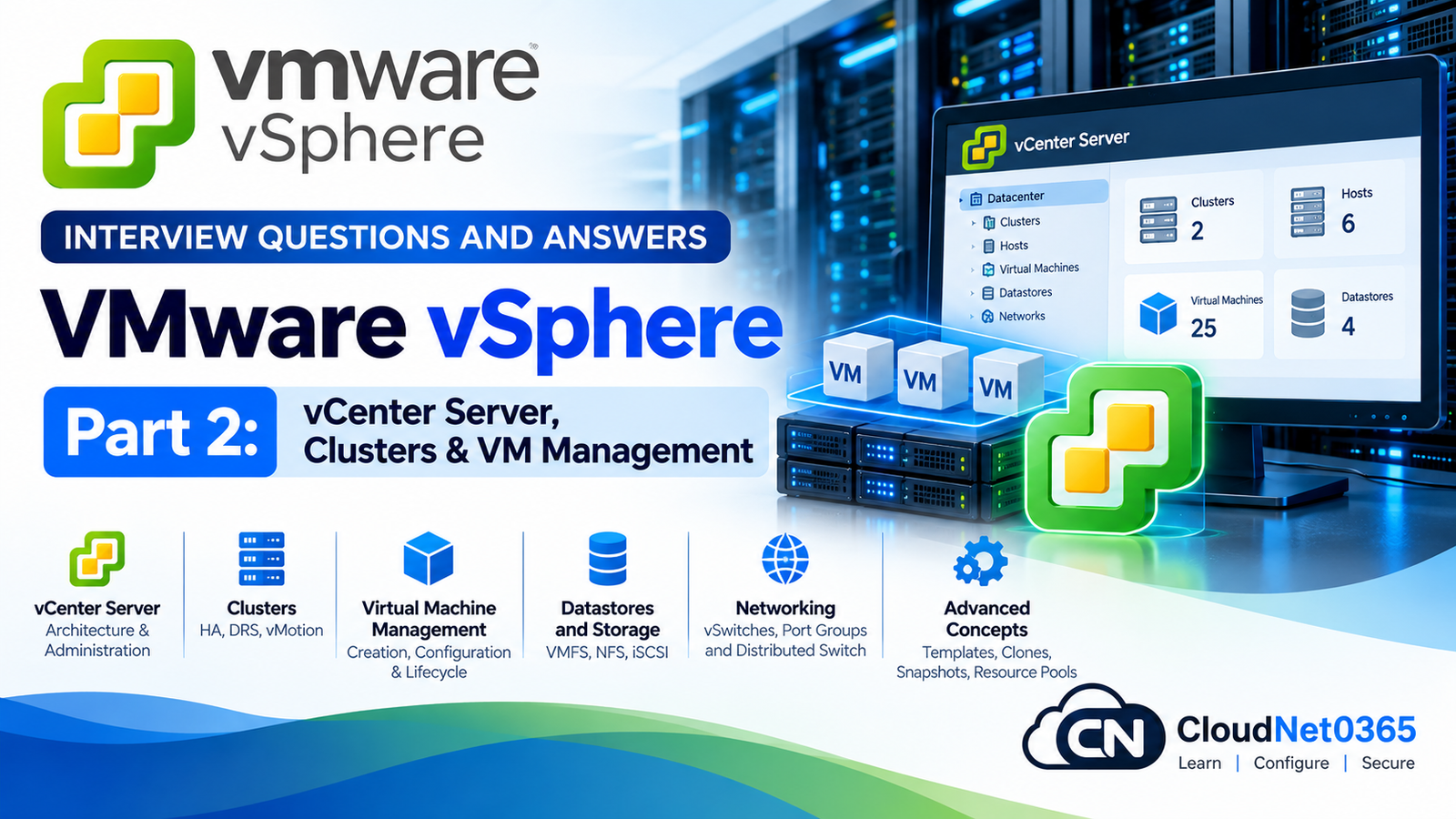
This part covers vCenter Server, VCSA, datacenters, clusters, ESXi host management, permissions, resource pools, VM provisioning, templates, cloning, Content Libraries, maintenance mode and common management scenarios.
VMware vSphere Interview Questions – Day 4 Part 2
1. What is vCenter Server?
Answer:
vCenter Server is VMware’s centralized management platform for managing vSphere infrastructure.
It provides a central management point for:
- ESXi hosts
- Virtual machines
- Clusters
- Datastores
- Virtual networks
- Resource pools
- Permissions
- Templates
- vMotion
- vSphere HA
- vSphere DRS
Instead of managing every ESXi host independently, administrators can manage the environment centrally through vCenter Server.
2. What is the difference between ESXi and vCenter Server?
Answer:
The simplest distinction is:
ESXi runs the virtual machines; vCenter Server centrally manages the vSphere environment.
| ESXi | vCenter Server |
|---|---|
| Hypervisor | Centralized management platform |
| Runs VMs | Manages ESXi hosts and VMs |
| Installed on physical servers | Runs as a virtual appliance |
| Provides compute virtualization | Provides centralized management |
| Can operate independently | Manages multiple vSphere resources |
For example, if vCenter becomes unavailable, VMs already running on ESXi hosts generally continue to run.
3. What is VCSA?
Answer:
VCSA (vCenter Server Appliance) is the preconfigured virtual appliance used to deploy vCenter Server.
It is based on VMware’s Photon OS and includes the components required to provide vCenter Server functionality.
Modern vSphere environments generally use the VCSA rather than the older Windows-based vCenter Server deployment model.
4. What are the major components of vCenter Server?
Answer:
The exact architecture depends on the vSphere version, but important vCenter services include:
- vCenter Server
- VMware vSphere Lifecycle Manager
- vSphere Authentication services
- vCenter Server APIs
- VMware vSphere UI
- Embedded vCenter database
In modern vSphere versions, many services that historically were deployed separately are integrated into the vCenter Server Appliance.
5. What is the vCenter Server Appliance database?
Answer:
The vCenter Server Appliance includes an embedded PostgreSQL database for storing vCenter configuration and inventory-related information.
It stores information such as:
- Inventory objects
- Configuration information
- Tasks
- Events
- Statistics and historical data, depending on configured retention
The database is an important component of vCenter Server.
6. What is the vSphere Client?
Answer:
The vSphere Client is the web-based management interface used to administer vSphere infrastructure.
Administrators can use it to manage:
- vCenter Server
- ESXi hosts
- VMs
- Clusters
- Datastores
- Networks
- Resource pools
- Permissions
- HA
- DRS
- Lifecycle management
7. Can you manage an ESXi host without vCenter Server?
Answer:
Yes.
An ESXi host can be managed directly using the ESXi Host Client.
However, centralized management and many cluster-level capabilities require vCenter Server.
For example:
- Cluster management
- vSphere DRS
- vSphere HA
- Centralized inventory
- Many migration workflows
require the appropriate vCenter-based configuration.
8. What is a vSphere Datacenter object?
Answer:
A vSphere Datacenter is a logical container in the vCenter inventory used to organize related hosts, clusters, VMs, networks and datastores.
It does not necessarily represent a physical data center building.
For example:
vCenter
   │
   ├── Datacenter-Ranchi
   │      ├── Cluster-Production
   │      ├── Hosts
   │      ├── VMs
   │      ├── Networks
   │      └── Datastores
   │
   └── Datacenter-DR
          ├── Cluster-DR
          └── Hosts
The naming and structure should reflect the organization’s management and operational requirements.
9. What is a vSphere cluster?
Answer:
A vSphere cluster is a logical collection of ESXi hosts managed together through vCenter Server.
Clusters enable capabilities such as:
- vSphere HA
- vSphere DRS
- Resource management
- Host maintenance and evacuation
- Workload balancing
- VM placement
A cluster allows multiple ESXi hosts to operate as a coordinated resource pool.
10. What are the prerequisites for adding an ESXi host to vCenter?
Answer:
Important requirements include:
- Network connectivity between vCenter and ESXi
- Correct DNS configuration where required
- Correct time synchronization
- Valid ESXi credentials
- Compatible versions/configuration
- Appropriate licensing
- Proper management networking
- ESXi host not already managed in a conflicting way
Before adding a host, I would verify DNS, time, network connectivity and ESXi management health.
11. Why is DNS important for VMware vSphere?
Answer:
DNS is important because vCenter Server and ESXi hosts rely on reliable name resolution for management and infrastructure communication.
DNS problems can cause:
- Host connection failures
- vCenter connectivity problems
- Certificate-related issues
- Migration problems
- Authentication problems
- General management instability
For production VMware environments, both forward and reverse DNS should be planned correctly according to VMware’s supported requirements.
12. Why is time synchronization important in VMware?
Answer:
Accurate time is important for:
- Authentication
- Kerberos-based services
- Certificates
- Logs
- Troubleshooting
- Distributed systems
- Correlating events across infrastructure
ESXi, vCenter and relevant infrastructure should use reliable time synchronization such as an organization-approved NTP source.
13. What is an ESXi host in vCenter?
Answer:
An ESXi host is a physical server running the ESXi hypervisor and registered with vCenter Server.
Once added to vCenter, the host can be centrally managed and may participate in a cluster.
Administrators can manage:
- VMs
- Datastores
- Networks
- VMkernel adapters
- Hardware
- Host configuration
- Maintenance mode
through vCenter.
14. What happens when you add an ESXi host to vCenter?
Answer:
vCenter establishes management of the ESXi host and adds its inventory to vCenter.
The administrator can then centrally manage:
- Virtual machines
- Datastores
- Networks
- Host configuration
- Cluster membership
- Permissions
- Tasks and events
If the host is added to a cluster, cluster-level features can also be applied according to the cluster configuration.
15. What happens if an ESXi host becomes disconnected from vCenter?
Answer:
The VMs already running on the ESXi host generally continue running.
However, vCenter can no longer perform normal management operations against that host while the connection is unavailable.
I would investigate:
- Network connectivity
- DNS
- ESXi management services
- Host health
- vCenter connectivity
- Certificates/time if relevant
- Firewall/security controls
- Recent configuration changes
The important distinction is:
A vCenter management connection failure is not automatically the same as an ESXi host failure.
16. What is the difference between “Not Responding” and “Disconnected” for an ESXi host?
Answer:
Both indicate that vCenter is not currently managing the host normally, but they can represent different conditions.
Not Responding generally means vCenter has lost communication with the host.
Disconnected means the host has been explicitly disconnected from vCenter or is otherwise intentionally not participating in normal vCenter communication.
When troubleshooting, I would verify the actual host state and network/management connectivity rather than assuming the two conditions have identical causes.
17. What is a resource pool?
Answer:
A resource pool is a logical allocation of CPU and memory resources within a vSphere environment.
It can be used to organize and control resources for groups of VMs.
Resource pools support concepts such as:
- Shares
- Reservations
- Limits
For example:
Production Cluster
       │
       ├── Database Resource Pool
       │       ├── DB01
       │       └── DB02
       │
       └── Application Resource Pool
               ├── APP01
               └── APP02
Resource pools should be designed carefully because poorly configured reservations and limits can cause unexpected resource contention.
18. What are Shares, Reservations and Limits?
Answer:
Shares
Shares determine relative priority when there is contention for a resource.
Reservation
A reservation guarantees a minimum amount of a resource for the object, subject to the applicable resource hierarchy and available capacity.
Limit
A limit places an upper boundary on how much of a resource an object can consume.
For example:
Reservation → Guaranteed minimum
Limit       → Maximum allowed
Shares      → Relative priority during contention
A common mistake is to configure limits without understanding their impact, which can unnecessarily restrict VM performance.
19. What is the difference between a cluster and a resource pool?
Answer:
A cluster is a collection of ESXi hosts managed together.
A resource pool is a logical subdivision of compute resources within the vSphere resource hierarchy.
Example:
Cluster
   │
   ├── ESXi-01
   ├── ESXi-02
   └── ESXi-03

Resource Pools
   │
   ├── Production
   └── Development
A cluster provides the host-level platform for features such as HA and DRS, while resource pools organize and control resource allocation.
20. What is vSphere HA?
Answer:
vSphere HA (High Availability) provides automatic VM restart capability when a host failure is detected in a properly configured HA cluster.
For example:
Before failure:

ESXi-01 → VM01
ESXi-02 → VM02

ESXi-01 fails
      ↓
HA detects failure
      ↓
VM01 is restarted on another suitable host
HA is primarily focused on availability through VM restart after host failure, rather than continuous execution of a VM across hosts.
Detailed HA concepts will be covered in Day 4 Part 3.
21. What is vSphere DRS?
Answer:
vSphere DRS (Distributed Resource Scheduler) helps manage VM placement and workload distribution across hosts in a cluster.
Depending on the configuration and vSphere version, DRS can make recommendations or perform automated placement/migration actions.
DRS considers available resources and configured policies when determining VM placement.
Detailed DRS concepts will be covered in Part 3.
22. What is Maintenance Mode?
Answer:
When an ESXi host enters Maintenance Mode, it is placed into a state intended for host maintenance.
Normally, administrators first evacuate or migrate workloads from the host.
Typical reasons include:
- ESXi patching
- Hardware maintenance
- Firmware updates
- Host replacement
- Troubleshooting
In a properly configured cluster, DRS and migration technologies can help evacuate workloads.
23. What happens to VMs when an ESXi host enters Maintenance Mode?
Answer:
The host cannot normally remain in Maintenance Mode with powered-on VMs running on it.
The VMs must be:
- Migrated to another host, or
- Powered off, depending on the environment and operation.
In a cluster with suitable DRS/vMotion configuration, VMs can often be migrated automatically or manually to other hosts.
24. What is vSphere Lifecycle Manager?
Answer:
vSphere Lifecycle Manager (vLCM) is VMware’s platform for managing ESXi host images, updates and lifecycle operations.
It can help administrators:
- Update ESXi hosts
- Apply patches
- Manage host images
- Maintain cluster consistency
- Check hardware compatibility in supported workflows
It is important in enterprise environments because manually maintaining every host independently can lead to configuration drift.
25. What is a host profile?
Answer:
A Host Profile captures a reference configuration for ESXi hosts and can be used to help maintain configuration consistency across hosts.
It can include configuration areas such as:
- Networking
- Storage
- Security
- System settings
Host Profiles are useful when multiple hosts need standardized configuration, although the exact capabilities and recommended workflows depend on the vSphere version.
26. What is VM provisioning?
Answer:
VM provisioning is the process of creating and configuring a virtual machine.
A typical workflow is:
Select host/cluster
       ↓
Select datastore
       ↓
Select VM hardware
       ↓
Configure CPU/RAM
       ↓
Configure network
       ↓
Create/attach virtual disk
       ↓
Install OS
       ↓
Install VMware Tools
       ↓
Configure OS
       ↓
Apply security/monitoring/backup
In enterprise environments, templates and Content Libraries can significantly simplify this process.
27. What is VM customization?
Answer:
VM customization allows administrators to apply guest-specific configuration when deploying a VM from a template.
Depending on the guest OS and supported vSphere functionality, customization can include:
- Computer name
- Network configuration
- Domain membership
- Security identifiers
- Other operating-system settings
The goal is to avoid manually configuring every newly deployed VM.
28. What is a VM template?
Answer:
A VM template is a standardized master image used to deploy new virtual machines.
A typical template might contain:
- Operating system
- Latest approved patches
- VMware Tools
- Required drivers
- Baseline configuration
- Standard applications
Templates improve consistency and reduce deployment time.
29. What is the difference between cloning a VM and deploying from a template?
Answer:
A clone creates a copy of an existing VM.
Template deployment creates a new VM based on a standardized template.
Templates are generally better for repeatable enterprise deployments because the source is maintained as an approved baseline.
Cloning can be useful when an existing VM needs to be copied for a particular purpose.
30. What is a Content Library?
Answer:
A Content Library provides centralized management and distribution of VM-related content such as:
- VM templates
- OVF/OVA packages
- ISO images
- Other supported files
Content Libraries can help standardize VM deployment across vSphere environments.
They are particularly useful in environments with multiple vCenter Servers or sites where content needs to be distributed consistently.
31. What is the difference between a local and subscribed Content Library?
Answer:
A local Content Library is managed by the vCenter environment where it is created.
A subscribed Content Library can consume published content from another Content Library according to the configured subscription and synchronization settings.
This can help distribute standardized templates and other content across sites.
32. What is an OVF?
Answer:
OVF (Open Virtualization Format) is a standard packaging format used to describe and distribute virtual appliances.
It can contain:
- Virtual machine configuration
- Virtual disks
- Metadata
- Hardware requirements
An OVF package may be distributed as multiple files.
33. What is an OVA?
Answer:
OVA (Open Virtual Appliance) is a single archive containing the files associated with an OVF package.
In simple terms:
OVF = package format that can consist of multiple files
OVA = single-file archive of an OVF package
OVF/OVA are commonly used to distribute virtual appliances.
34. What are VMware permissions?
Answer:
vSphere permissions determine what authenticated users or groups are allowed to do with inventory objects.
A permission generally combines:
- A user or group
- A role
- An inventory object
- Propagation/inheritance settings
For example, an administrator might grant a help-desk group limited VM management rights without giving them full vSphere Administrator privileges.
35. What is a role in vSphere?
Answer:
A role is a collection of privileges that defines what operations a user or group can perform.
Examples include permissions related to:
- VM power operations
- VM configuration
- Datastore access
- Network management
- Host management
The principle of least privilege should be followed when designing vSphere permissions.
36. What is privilege inheritance in vSphere?
Answer:
Permissions can be applied at different levels of the vSphere inventory hierarchy.
When inheritance is enabled, the permission can propagate to child objects according to the configured hierarchy and permission model.
For example:
Datacenter
   ↓
Cluster
   ↓
Host
   ↓
VM
An administrator should understand where the permission was assigned and whether it is inherited before troubleshooting access problems.
37. A user can log in to vCenter but cannot see a VM. What would you check?
Answer:
I would check:
- User authentication
- Group membership
- vSphere role
- Permission assigned to the user/group
- Inventory object where the permission was assigned
- Permission propagation/inheritance
- Whether another permission affects the effective access
- Whether the user is looking at the correct vCenter/Datacenter
I would use least privilege rather than simply granting the user Administrator access.
38. An administrator can see a VM but cannot power it on. What would you check?
Answer:
I would distinguish between visibility and operational privileges.
I would check:
- Assigned role
- Power-operation privileges
- Permission inheritance
- VM-level permissions
- Resource availability
- Datastore availability
- Host status
- Any VM configuration or lock issue
- Cluster placement/resource constraints
If the user can view the VM but cannot perform a power operation, insufficient privileges are one possible cause.
39. What is the difference between a VM snapshot and a VM clone?
Answer:
A snapshot captures a point-in-time state of a VM’s virtual disk state and optionally its memory state depending on how the snapshot is created.
A clone creates a separate VM based on another VM.
Therefore:
Snapshot = point-in-time state
Clone = separate VM copy
They serve different purposes and should not be treated as interchangeable.
40. What is the difference between a template and a snapshot?
Answer:
A template is a standardized source used to deploy new VMs.
A snapshot is a point-in-time state associated with an existing VM.
For example:
Template
   ↓
Deploy VM01
Deploy VM02
Deploy VM03
Whereas:
VM01
  ↓
Snapshot
  ↓
Test configuration change
A snapshot is not a deployment template and should not be used as a replacement for proper VM backup.
41. What is Storage vMotion?
Answer:
Storage vMotion allows the virtual disks and related VM files to be migrated between supported datastores while the VM remains powered on, subject to the applicable compatibility and configuration requirements.
For example:
VM01
  │
  ├── Datastore-A
  │
  └── Storage vMotion
          ↓
      Datastore-B
It is commonly used for:
- Storage maintenance
- Datastore balancing
- Storage migration
- Storage performance management
Detailed migration technologies will be covered in Part 3.
42. What is vMotion?
Answer:
vMotion allows a running VM to be migrated from one compatible ESXi host to another with minimal service interruption.
For example:
ESXi-01
   │
   │ vMotion
   ↓
ESXi-02

VM continues running
vMotion requires appropriate configuration and compatibility between the source and destination environments.
Detailed vMotion prerequisites and troubleshooting will be covered in Part 3.
43. An ESXi host cannot be added to vCenter. What would you troubleshoot?
Answer:
I would follow a structured approach:
1. Network
Check connectivity between vCenter and ESXi.
2. DNS
Verify forward and reverse name resolution as required.
3. Time
Check time synchronization.
4. Credentials
Verify the ESXi administrative credentials.
5. ESXi health
Check management services and host health.
6. Version compatibility
Check whether the ESXi and vCenter versions are supported together.
7. Certificates/security
Check certificate and security-related errors if reported.
8. Existing management
Check whether the host is already registered or has an existing configuration that prevents the operation.
I would then review the exact vCenter task/error message and ESXi/vCenter logs.
44. vCenter Server is unavailable. What would you do first?
Answer:
First, I would determine whether the problem is with:
- VCSA itself
- Underlying ESXi host
- Storage
- Network
- DNS
- Authentication
- vCenter services
I would also confirm whether production VMs are still running.
If VMs are running normally, I would focus on restoring the management plane without unnecessarily disrupting workloads.
If required, I would use the ESXi Host Client to verify individual hosts and VM status while vCenter is unavailable.
45. How would you troubleshoot a vCenter Server Appliance that is running but the vSphere Client is inaccessible?
Answer:
I would check the problem layer systematically:
- Can I reach the VCSA IP address?
- Does DNS resolve correctly?
- Is the management interface reachable?
- Are vCenter services running?
- Is the VCSA healthy?
- Is storage full?
- Is CPU or memory exhausted?
- Are certificates expired or otherwise causing problems?
- Are there relevant VCSA/vCenter events and logs?
- Were there recent changes or upgrades?
I would avoid immediately rebooting the appliance without understanding the cause.
46. What happens if the vCenter Server Appliance datastore becomes full?
Answer:
A full or critically low filesystem can cause vCenter services to malfunction.
Potential symptoms include:
- vSphere Client becoming unavailable
- Services failing
- Database-related problems
- Logging problems
- Update/upgrade failures
- General vCenter instability
I would identify which filesystem is full, determine what is consuming space, check logs and database-related usage, and recover capacity safely according to VMware-supported procedures.
47. A VM is visible in vCenter but its datastore is inaccessible. What would you check?
Answer:
I would check the storage path from the ESXi host:
VM
 ↓
Datastore
 ↓
Storage adapter
 ↓
Storage path
 ↓
SAN/NAS
 ↓
Storage array
I would investigate:
- Datastore accessibility
- Storage adapters
- HBA/iSCSI status
- Storage paths
- Multipathing
- Network connectivity for NFS/iSCSI
- Storage array health
- Recent storage changes
- ESXi storage events/logs
The goal is to determine whether the problem is datastore-level, host-level, network-level or array-level.
48. What is configuration drift in a VMware environment?
Answer:
Configuration drift occurs when hosts that are intended to have standardized configurations gradually become different.
For example:
ESXi-01 → Correct configuration
ESXi-02 → Correct configuration
ESXi-03 → Different VLAN configuration
ESXi-04 → Different NTP configuration
Drift can cause:
- vMotion failures
- Networking inconsistencies
- Security differences
- Troubleshooting complexity
- Cluster configuration problems
Tools and processes such as vSphere Lifecycle Manager, Host Profiles and standardized configuration management can help reduce drift, depending on the environment and vSphere version.
49. How would you safely remove an ESXi host from a vCenter cluster?
Answer:
I would first ensure that the host is safe to remove.
Typical process:
- Review running VMs.
- Migrate or evacuate workloads.
- Check datastore dependencies.
- Check networking dependencies.
- Verify cluster features and dependencies.
- Place the host into Maintenance Mode.
- Remove the host from the cluster/vCenter according to the required procedure.
I would also confirm whether the host has any workloads or infrastructure dependencies before removal.
50. You are asked to design a basic VMware production environment. What would you consider?
Answer:
I would consider the design in multiple layers:
Compute
- Number of ESXi hosts
- CPU and memory sizing
- NUMA
- Hardware compatibility
Management
- vCenter Server
- DNS
- NTP
- Authentication
- Monitoring
Storage
- VMFS/NFS/vSAN as appropriate
- Capacity
- Performance
- Redundancy
- Multipathing
- Backup
Networking
- Management network
- VM networks
- vMotion
- Storage traffic
- Redundancy
- VLANs
- NIC teaming
Availability
- vSphere HA
- DRS
- Host redundancy
- Storage redundancy
- Network redundancy
Security
- Least-privilege permissions
- Host security
- Network segmentation
- Secure management access
- Logging and monitoring
Operations
- Patch management
- Configuration consistency
- Backup
- Disaster recovery
- Capacity monitoring
- Documentation
The final design should be based on workload requirements, business availability requirements, supported hardware/software versions and the organization’s operational standards.
Essential vCenter & ESXi Troubleshooting Commands
When vCenter is available, use the vSphere Client and supported management workflows wherever practical.
For ESXi troubleshooting, commonly useful commands include:
esxcli system version getCheck ESXi version.
esxcli network nic listCheck physical NICs.
esxcli network ip interface listCheck VMkernel interfaces.
esxcli storage filesystem listCheck mounted datastores/filesystems.
esxcli storage core path listCheck storage paths.
vim-cmd vmsvc/getallvmsList registered VMs.
vim-cmd vmsvc/power.getstate <VMID>Check VM power state.
vim-cmd vmsvc/get.summary <VMID>Retrieve VM summary information.
Quick Revision – vCenter & VM Management
- ESXi → Runs virtual machines.
- vCenter Server → Centrally manages vSphere infrastructure.
- VCSA → vCenter Server Appliance.
- vSphere Client → Web-based management interface.
- Datacenter → Logical vCenter inventory container.
- Cluster → Group of ESXi hosts managed together.
- Resource Pool → Logical allocation of compute resources.
- Shares → Relative priority during resource contention.
- Reservation → Minimum guaranteed resource allocation, subject to the resource hierarchy.
- Limit → Maximum resource consumption allowed.
- Maintenance Mode → Used to prepare an ESXi host for maintenance.
- vSphere HA → Restarts affected VMs after supported host failures.
- DRS → Helps with VM placement and workload balancing.
- vMotion → Migrates a running VM between compatible hosts.
- Storage vMotion → Migrates VM storage between supported datastores.
- Template → Standardized source for VM deployment.
- Clone → Copy of an existing VM.
- Content Library → Centralized management/distribution of supported VM content.
- OVF → Virtual appliance packaging format.
- OVA → Single-file archive of an OVF package.
- vSphere permissions → Combine user/group, role, object and propagation settings.
- Least privilege → Give users only the permissions they need.
- Configuration drift → Unwanted differences between supposedly standardized hosts.
- vCenter failure → Management is affected, but running VMs on healthy ESXi hosts generally continue running.
Exam Answer Summary
If the interviewer asks these common questions:
What is vCenter?
vCenter Server is the centralized management platform for managing ESXi hosts, VMs, clusters, storage and networking.
What is the difference between ESXi and vCenter?
ESXi is the hypervisor that runs VMs; vCenter centrally manages the vSphere infrastructure.
What happens if vCenter goes down?
Running VMs generally continue running on ESXi hosts, but centralized management and vCenter-dependent operations are affected.
What is a cluster?
A cluster is a group of ESXi hosts managed together to provide capabilities such as HA, DRS and centralized resource management.
What is a resource pool?
A resource pool is a logical way to organize and control CPU and memory resources for workloads.
What is Maintenance Mode?
It prepares an ESXi host for maintenance by allowing workloads to be evacuated or otherwise handled before host maintenance.
What is a template?
A standardized VM source used to deploy new virtual machines consistently.
What is a Content Library?
A centralized repository for managing and distributing supported VM templates, OVF/OVA packages, ISO files and other content.
How do you troubleshoot an ESXi host that cannot connect to vCenter?
Check network connectivity, DNS, time synchronization, credentials, ESXi management services, version compatibility, certificates/security and relevant logs.
How do you troubleshoot a slow VM?
Check CPU Ready, memory contention, ballooning/swapping, storage latency, network performance, guest OS/application metrics and recent changes before increasing resources.
Final Interview Tip
For senior VMware interviews, don’t answer only with definitions.
Try to structure your answer like this:
Definition → Purpose → Prerequisites → How it works → Troubleshooting
For example, if asked about vCenter Server, don’t stop at “It centrally manages ESXi hosts.”
Explain what it manages, what happens when it fails, how you troubleshoot it, and how it fits into the overall vSphere architecture.
That is the level of understanding expected from a senior System Administrator/System Engineer.
Next Part
Day 4 Part 3 – vMotion, vSphere HA, DRS & Advanced Availability
This part will cover:
- vMotion architecture and prerequisites
- vMotion networking
- Storage vMotion
- Cross-vCenter migration
- vSphere HA architecture
- Admission Control
- Host isolation
- HA failover
- VM Monitoring
- DRS
- DRS automation
- Affinity/anti-affinity rules
- EVC
- Fault Tolerance
- Maintenance/evacuation scenarios
- Real-world HA, DRS and vMotion troubleshooting scenarios