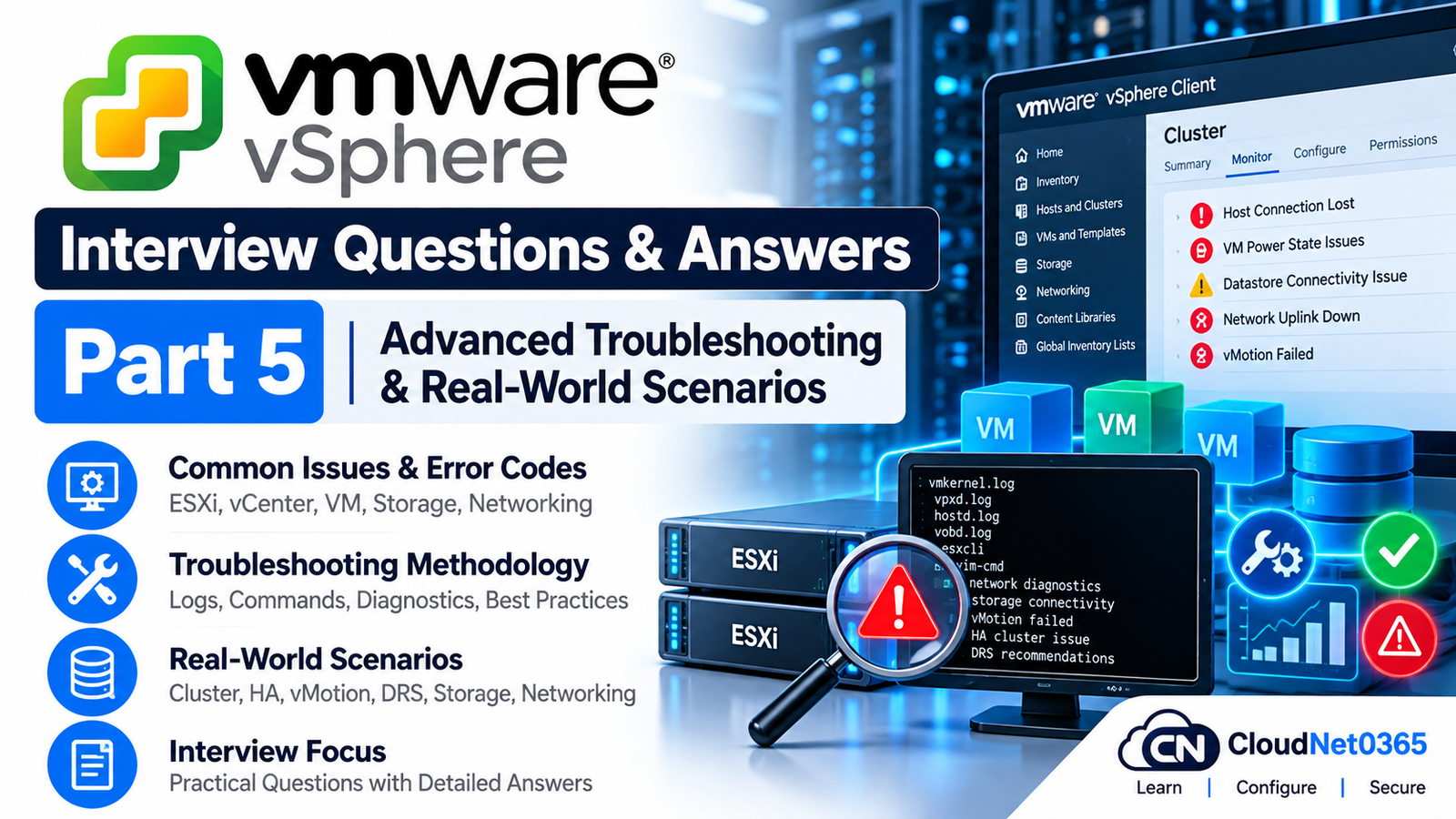
This is the final part of the VMware vSphere interview series.
Parts 1–4 already covered the core VMware concepts, vCenter, clusters, VM management, vMotion, HA, DRS, storage and networking.
Therefore, this part does not repeat those fundamentals.
Instead, the questions focus on situations a senior VMware administrator may encounter in a production environment:
- ESXi host failures
- vCenter failures
- VM power-on problems
- VM hangs
- VMware Tools problems
- Guest OS versus VMware problems
- Snapshot consolidation failures
- Datastore capacity incidents
- Storage presentation problems
- VMkernel troubleshooting
- Log analysis
- ESXi management failures
- Hardware problems
- DRS/HA incident investigation
- Configuration drift
- Production incident handling
- Root-cause analysis
- Preventive actions
The objective is to demonstrate how you troubleshoot, not simply how many VMware terms you can memorize.
Advanced VMware Troubleshooting & Real-World Scenarios
Q1. A VM is completely unresponsive. How do you determine whether the problem is inside the guest OS or at the VMware layer?
I would first determine whether the VM is actually running and responding at the hypervisor level.
I would check:
- VM power state.
- vCenter Tasks and Events.
- VM console.
- CPU and memory activity.
- VMware Tools status.
- Virtual disk activity.
- Network activity.
- Whether other VMs on the same host are affected.
If the VM console is responsive but the application is not, I would investigate the guest OS/application.
If the VM itself is frozen and VMware operations such as console interaction or power operations are also affected, I would investigate the ESXi host, storage and VM process.
The important point is to separate:
Guest problem → VM configuration problem → ESXi problem → storage/network/infrastructure problem.
Q2. VMware Tools shows “Not Running” on a production VM. What would you check?
I would not immediately assume that the VM itself is faulty.
I would check:
- Whether VMware Tools is installed.
- Whether the VMware Tools service is running.
- Guest OS services.
- Guest OS event logs.
- VMware Tools version/status.
- Whether the VM recently rebooted.
- Whether the VM is responsive.
- Whether the guest OS is supported.
For Windows, I would verify the VMware Tools service.
For Linux, I would check the appropriate VMware Tools/open-vm-tools service.
I would also verify whether the VM is otherwise operating normally.
Q3. A VM’s VMware Tools service is running, but vCenter still reports outdated Tools information. What would you investigate?
I would check:
- VMware Tools version.
- VM power state.
- vCenter communication with the ESXi host.
- ESXi management agents.
- VMX process status.
- Recent host/vCenter connectivity problems.
- Whether the Tools status is stale.
I would refresh or restart the appropriate management component only after confirming that the guest itself is healthy.
I would avoid unnecessarily rebooting a production VM simply to refresh a management status.
Q4. An ESXi host is connected to vCenter but appears to be behaving abnormally. What would you check before rebooting it?
I would first determine whether the problem is:
- vCenter communication only
- ESXi management plane
- Network connectivity
- Storage connectivity
- VM performance
- Physical hardware
I would check:
- Host alarms
- Recent Tasks and Events
- Hardware health
- Datastore accessibility
- VMkernel interfaces
- Physical NICs
- Storage paths
- ESXi logs
- Management-agent health
A reboot should be a controlled decision, especially if production VMs are still running.
Q5. What is the difference between a VM being powered off and a VM being inaccessible?
A powered-off VM is normally still manageable through vCenter/ESXi and its configuration files remain accessible.
An inaccessible VM may indicate that VMware cannot access the VM’s configuration or storage location.
Possible causes include:
- Datastore unavailable
- Storage path failure
- VM files moved/deleted
- Storage presentation problem
- File-system issue
- Host connectivity problem
Therefore, an inaccessible VM should not be treated simply as a powered-off VM.
Q6. A VM appears as “Inaccessible” in vCenter. What would you investigate?
I would first check the datastore containing the VM.
Then:
- Is the datastore accessible?
- Is it mounted on the ESXi host?
- Are storage paths healthy?
- Is the underlying storage available?
- Can other VMs on the same datastore be accessed?
- Is the VM configuration file present?
- Was the VM recently moved or deleted?
- Are there storage-array or SAN/NFS problems?
I would avoid unregistering or deleting the VM until the storage situation is understood.
Q7. A VM is visible in vCenter but its datastore is inaccessible on one ESXi host. What is your approach?
I would compare the affected host with a healthy host.
Check:
- Storage adapters
- LUN visibility
- NFS connectivity if applicable
- VMkernel networking
- Storage paths
- Multipathing
- SAN zoning
- LUN masking
- Storage-array presentation
- ESXi logs
If the same datastore works correctly on other hosts, I would focus on the affected host rather than changing the datastore itself.
If multiple independent shared datastores disappear simultaneously from one host, I would investigate the host’s common storage path rather than assuming that all datastores failed independently.
Possible causes include:
- HBA failure
- Storage network failure
- FC fabric problem
- iSCSI networking problem
- VMkernel failure
- Storage-array connectivity issue
- Driver/firmware issue
- Physical switch/fabric problem
The scope of the failure is an important diagnostic clue.
Q9. How would you distinguish a storage-array problem from an ESXi host storage problem?
I would compare multiple ESXi hosts.
For example:
- If only one ESXi host loses access while others remain healthy, investigate that host and its paths first.
- If multiple hosts lose access to the same storage simultaneously, investigate the shared storage infrastructure.
- If all hosts lose access to multiple datastores, investigate the storage array/fabric/network and recent changes.
I would correlate:
- vCenter events
- ESXi logs
- storage paths
- HBA/NIC status
- storage-array events
before determining the root cause.
Q10. A datastore has suddenly lost free space. How would you investigate?
I would identify what consumed the capacity.
Possible causes include:
- VM disk growth
- Snapshot growth
- ISO files
- Templates
- Logs
- Backup-related files
- Large files left on the datastore
- Another VM consuming unexpected space
I would inspect datastore contents and VM storage usage.
I would also check whether a snapshot chain is growing rapidly.
I would not delete unknown files simply to create free space.
VM Power and Configuration Problems
Q11. A VM fails to power on with a “file not found” type error. What would you check?
I would identify which file is missing.
Common VM files include:
.vmx.vmdk- snapshot delta files
.nvram
I would verify:
- Datastore accessibility.
- VMX file existence.
- VMDK descriptor and data-file availability.
- Snapshot chain.
- Whether files were manually moved.
- Whether the VM was recently restored or migrated.
I would never create or edit disk descriptor files blindly without understanding the virtual-disk chain.
Q12. A VM fails to power on because the datastore is full. What should you do?
First, confirm the datastore capacity problem.
Then identify safe ways to recover space, such as:
- Removing unnecessary ISO files.
- Moving appropriate non-production files.
- Expanding the datastore where supported.
- Addressing unnecessary snapshots.
- Moving suitable VMs.
- Increasing underlying storage capacity.
If snapshots are involved, I would ensure sufficient space for consolidation before attempting it.
I would never manually delete snapshot delta files.
Q13. A VM is stuck in a power operation. What would you do?
I would first check the vCenter task and determine whether the operation is actually progressing.
Then check:
- VM responsiveness
- ESXi host health
- Storage accessibility
- VM process state
- Recent host issues
- Other affected VMs
If normal vSphere operations cannot complete, I would investigate the VM’s process state on the ESXi host and follow VMware-supported procedures.
I would avoid repeatedly issuing power operations because that can make troubleshooting more difficult.
Q14. A VM cannot be powered on because another host appears to have a lock on its files. What does this mean?
VMware uses file locking mechanisms to prevent multiple hosts from incorrectly accessing VM files simultaneously.
A stale or legitimate lock may exist because:
- The VM is actually running elsewhere.
- A previous operation did not complete cleanly.
- The host still believes the VM is active.
- Storage connectivity was interrupted.
I would first determine whether another ESXi host is actually running the VM.
I would not manually remove lock files without determining the source of the lock and following supported VMware procedures.
Q15. A VM was accidentally removed from inventory. Are the VM’s files deleted?
Not necessarily.
Removing a VM from inventory is different from deleting its files from the datastore.
If the files still exist, the VM can potentially be registered again from its .vmx configuration file.
Before registering it, I would verify:
- VM files are intact.
- The VM is not already registered elsewhere.
- No duplicate VM is running.
- Storage is healthy.
Snapshot and Backup Troubleshooting
Q16. A backup job repeatedly fails because of VMware snapshot problems. What would you investigate?
I would check:
- Existing snapshots.
- Snapshot age and size.
- Datastore free space.
- Backup software logs.
- Snapshot creation/removal tasks.
- CBT-related errors if applicable.
- Storage latency.
- Whether previous backup jobs left snapshots behind.
- Whether snapshot consolidation is required.
I would also verify whether another backup job is currently operating on the same VM.
Q17. What is Changed Block Tracking (CBT), and why can it matter during backups?
Changed Block Tracking allows supported backup applications to identify which disk blocks have changed since a previous backup.
This can reduce the amount of data that needs to be processed for incremental backups.
CBT problems can therefore affect backup efficiency or backup correctness.
If a backup product reports a CBT-related problem, I would follow the backup vendor’s and VMware’s supported procedure rather than manually modifying CBT files without understanding the impact.
Q18. A VM has “Consolidation Needed” after a backup job. What would you do?
I would:
- Confirm the backup job has completed.
- Check whether another backup job is active.
- Check datastore free space.
- Review the snapshot chain.
- Verify storage health.
- Perform supported snapshot consolidation if required.
- Monitor the datastore during consolidation.
If consolidation fails, I would investigate the exact error rather than repeatedly clicking Consolidate.
vCenter Troubleshooting
Running VMs generally continue to run on ESXi hosts.
The loss of vCenter does not automatically power off all VMs.
However, centralized management capabilities are affected.
Depending on the environment, administrators may temporarily lose access to:
- vSphere Client management
- Cluster management
- DRS management
- Centralized inventory
- vCenter-based operations
- Some automation and management workflows
HA protection can continue to operate through the ESXi/HA architecture if the cluster was already configured and the required components remain healthy.
Q20. vCenter Server Appliance is down. How would you troubleshoot it?
I would first determine whether the problem is:
- VCSA power state
- VCSA operating system
- Network
- DNS
- Storage
- Certificate/services
- Database/service startup
I would check the VCSA console and available management interfaces.
I would also determine whether the underlying datastore is accessible and whether the VCSA itself has sufficient storage capacity.
I would avoid making destructive changes to the VCSA without identifying the failed component.
I would separate:
VCSA availability
from:
vSphere Client/service availability.
Check:
- Network connectivity
- DNS
- HTTPS access
- VCSA service status
- VCSA resource utilization
- Disk capacity
- Certificates
- Recent changes
- VCSA logs
The fact that the VCSA VM is powered on does not prove that all vCenter services are healthy.
Q22. vCenter services repeatedly stop because the VCSA datastore is full. What would you investigate?
I would identify which VCSA file system or datastore is full.
Then check:
- VCSA logs
- Database growth
- Historical log retention
- Core dumps
- Backup/restore files
- Datastore capacity
- Other VMs consuming the datastore
I would use supported VCSA procedures to clean up or expand storage.
I would not randomly delete files from VCSA system directories.
Q23. vCenter reports an ESXi host as “Not Responding.” What is your troubleshooting sequence?
I would check from the outside in:
1. Network
Can the host management IP be reached?
2. Physical host
Is the server powered on?
3. Hardware
Are there hardware alarms?
4. ESXi management
Are management services responding?
5. Storage
Are shared datastores still accessible?
6. VMs
Are the VMs still running?
7. vCenter
Is vCenter itself healthy?
8. Logs
Check ESXi and vCenter events/logs.
I would not immediately remove and re-add the host.
ESXi Logs and Diagnostics
Q24. Which ESXi logs are important for troubleshooting?
Important logs include:
/var/log/vmkernel.log/var/log/vobd.log/var/log/hostd.log/var/log/vpxa.log
Broadly:
vmkernel.log
Useful for:
- Storage
- Networking
- Hardware
- VMkernel-related events
hostd.log
Useful for:
- ESXi host management
- Local host operations
- VM management
vpxa.log
Useful for:
- ESXi host communication with vCenter
vobd.log
Useful for:
- VMkernel Observation events and host events
The exact diagnostic location and log behavior can vary by ESXi release, so always use the documentation for the installed version.
Q25. What is the difference between hostd and vpxa?
hostd
The ESXi host management service.
It handles many local management operations involving:
- VMs
- Host configuration
- Datastores
- Host management
vpxa
The vCenter Server agent running on the ESXi host.
It facilitates communication between the ESXi host and vCenter Server.
A simplified relationship is:
vCenter Server
      ↓
    vpxa
      ↓
    hostd
      ↓
ESXi management
This is a simplified troubleshooting model rather than a complete representation of all vSphere internal components.
Network Troubleshooting
Q26. An ESXi host has management connectivity problems, but VMs are still reachable. What does this suggest?
This can indicate that the problem is specific to the ESXi management path rather than all host networking.
I would compare:
- Management VMkernel adapter
- VM network
- Physical uplinks
- VLANs
- Switch ports
- NIC teaming
- Routing
- Firewall rules
I would also determine whether other VMkernel services such as vMotion or storage networking are affected.
The fact that VMs remain reachable does not automatically mean that the physical network is completely healthy.
Q27. vMotion works between hosts, but ESXi management connectivity is unstable. What would you compare?
I would compare the VMkernel adapters used by the two services.
Check:
- IP configuration
- VLAN
- Port group
- Physical uplink
- NIC teaming
- MTU
- Routing
- Physical switch configuration
Different VMkernel interfaces may use different networks and uplinks.
Therefore, one VMkernel service can work while another is experiencing problems.
Q28. How would you troubleshoot intermittent packet loss affecting a VM?
I would determine whether the packet loss occurs:
- Inside the guest
- Between VM and ESXi
- Between ESXi and physical switch
- Across the physical network
- At the destination
Then check:
- Guest NIC
- VM vNIC
- Port group
- VLAN
- vmnic errors
- Physical switch port errors
- Duplex/speed
- MTU
- Network congestion
- NIC driver/firmware
- Physical cabling
I would use packet counters and network monitoring rather than relying only on repeated ping tests.
Hardware and ESXi Host Problems
Q29. An ESXi host reports a degraded physical disk. What would you do?
I would first determine whether the disk is:
- Part of a RAID controller
- Used for a VMFS datastore
- Used by vSAN
- Used for another storage configuration
Then check:
- Hardware controller status
- Physical disk health
- RAID state
- Storage redundancy
- VMware storage status
- Vendor hardware-management logs
I would follow the server/storage vendor’s replacement procedure.
I would not remove a disk blindly from a production system.
Q30. An ESXi host reports a failed NIC. What is the potential impact?
The impact depends on the network design.
If redundant uplinks are configured correctly, traffic may fail over to another physical NIC.
However, the impact depends on which services use the failed uplink:
- Management
- VM traffic
- vMotion
- Storage
- vSAN
- Other VMkernel services
I would check whether failover actually occurred and whether any traffic remains degraded.
Q31. How would you investigate an ESXi host hardware alarm?
I would identify the exact hardware component involved.
Check:
- CPU
- Memory
- Fan
- Power supply
- Temperature
- RAID controller
- Disk
- NIC
- HBA
Then correlate:
- vCenter hardware alarms
- ESXi logs
- Hardware-management controller logs
- Vendor diagnostics
I would avoid clearing an alarm without determining its cause.
Configuration and Operational Troubleshooting
Q32. Two ESXi hosts have different networking behavior even though they are supposed to be identical. How would you troubleshoot configuration drift?
I would compare:
- VSS/VDS configuration
- Port groups
- VLANs
- VMkernel adapters
- Uplinks
- NIC teaming
- MTU
- DNS
- NTP
- Storage adapters
- Datastore configuration
- Host configuration
If Host Profiles or vSphere Lifecycle Manager configuration management is being used, I would check compliance information.
The goal is to identify the exact configuration difference rather than manually changing both hosts until they appear to work.
Q33. A VM works on one ESXi host but fails after migration to another. What is your troubleshooting strategy?
I would compare the source and destination hosts across all dependencies.
Compute
- CPU compatibility
- Resources
- NUMA
Storage
- Datastore access
- Storage paths
- VM disk accessibility
Network
- Port group
- VLAN
- uplinks
- physical network
Policies
- DRS rules
- VM/host affinity
- Security configuration
Guest/VM
- vNIC
- virtual hardware
- VMware Tools
The difference between the working and failing host is often the key to finding the problem.
Q34. A VM has suddenly started consuming much more storage. What would you check?
I would determine which virtual disk or file is growing.
Possible causes:
- Guest OS data growth
- Application/database growth
- Windows shadow copies
- Linux logs
- VM snapshot
- Backup-related snapshot
- Thin-provisioned VMDK growth
I would check both:
Guest-level disk usage
and
VMware datastore/VMDK usage.
These are not always the same thing.
HA/DRS Incident Scenarios
Q35. HA reports that a VM was restarted after a host failure. How would you verify that the recovery was successful?
I would verify:
- VM power state.
- Destination ESXi host.
- Application availability.
- Guest OS health.
- VMware Tools status.
- Network connectivity.
- Storage access.
- Application logs.
- vCenter HA events.
A VM being powered on does not necessarily mean that the application recovered correctly.
Q36. A VM repeatedly moves between hosts. What could cause this?
Possible causes include:
- DRS recommendations/automation
- Resource imbalance
- Host maintenance
- HA recovery
- Manual migrations
- Affinity/anti-affinity configuration
- Host problems
- Automated management workflows
I would check vCenter Tasks and Events to determine who or what initiated each migration.
I would not assume DRS is responsible without checking the event history.
Q37. DRS repeatedly recommends a migration but never performs it automatically. What would you check?
Check:
- DRS automation level
- Cluster configuration
- VM-specific settings
- DRS rules
- Resource reservations
- VM limits
- Host compatibility
- vMotion health
- Whether the recommendation is actually actionable
If the cluster is configured for manual or partially automated operation, recommendations may require administrator intervention.
Production Incident Management
Q38. A production VM has degraded performance immediately after a VMware change. What would you do?
I would establish:
- Exactly what changed.
- When it changed.
- Which VM was affected.
- Whether other VMs were affected.
- Whether the problem correlates directly with the change.
If the change is clearly associated with the incident and rollback is safe and approved, I would consider reverting it.
However, I would preserve evidence and document the change before modifying the environment again.
Q39. How do you determine whether a VMware problem is actually an application problem?
I would correlate application performance with infrastructure metrics.
For example:
Application response time
        ↓
Guest CPU / Memory
        ↓
VM CPU / Memory
        ↓
Datastore latency
        ↓
Storage infrastructure
        ↓
Network
If VMware resources are healthy but the application is consuming excessive CPU or waiting on an internal database/query, the problem may be inside the application stack.
A VMware administrator should avoid blaming the hypervisor without evidence.
Q40. What information should you collect before making a major production VMware change?
I would collect:
- Current configuration
- VM inventory
- Cluster configuration
- Storage layout
- Network configuration
- Current performance metrics
- Recent events
- Existing backups
- Dependencies
- Maintenance window
- Rollback plan
- Expected impact
For a significant change, I would also document the change and obtain the required approval.
Senior-Level Scenarios
Q41. A datastore is nearly full, snapshots are present, and a backup job is currently running. What should you do?
I would not immediately delete the snapshots.
First:
- Confirm the backup job status.
- Identify the snapshot chain.
- Determine snapshot size.
- Check datastore free space.
- Determine whether the backup application is actively using the snapshot.
- Identify safe temporary capacity if necessary.
- Coordinate with the backup process.
- Consolidate snapshots using supported procedures when safe.
- Monitor datastore capacity.
The priority is to prevent the datastore from reaching a critical capacity condition while avoiding snapshot-chain corruption.
Q42. Multiple VMs on one datastore become slow, but VMs on other datastores are normal. What does this tell you?
It strongly suggests that the shared dependency may be the affected datastore or its underlying storage path.
I would investigate:
- Datastore latency
- IOPS
- Throughput
- Storage device latency
- Storage paths
- Multipathing
- Storage array
- Other VMs generating heavy I/O
- Recent storage changes
I would compare the affected datastore with a healthy datastore.
Q43. Multiple VMs on different datastores but the same ESXi host become slow. What would you investigate?
The common dependency is now more likely to be the ESXi host or its shared infrastructure.
I would check:
- Host CPU
- Memory
- Network
- Storage adapters
- Hardware health
- ESXi logs
- Host-level contention
- Physical NIC/HBA problems
- Host configuration
If VMs on other hosts remain healthy, I would focus strongly on the affected host.
Q44. VMs across several ESXi hosts and several datastores become slow simultaneously. What would you investigate?
Because the affected workloads cross host and datastore boundaries, I would look for shared infrastructure.
Potential areas:
- Core network
- Storage fabric
- Storage array
- DNS
- Authentication infrastructure
- External application dependencies
- Backup/security systems
- Recent infrastructure changes
This is a good example of why scope analysis is important.
Q45. A VM has high CPU usage, but the application owner says the application is slow because of VMware. How would you prove or disprove that?
I would collect evidence rather than assume either side is correct.
Check:
- Guest CPU usage
- Processes consuming CPU
- VM CPU usage
- CPU Ready
- Co-Stop
- CPU limits
- Host contention
- Application logs
- Database performance
- Storage latency
- Network latency
If the guest process itself is consuming CPU while VMware CPU scheduling is healthy, the bottleneck may be inside the guest/application.
If the VM has significant CPU Ready or is constrained by a limit, VMware resource scheduling may be contributing.
Q46. A VM is showing high memory usage inside Windows, but ESXi shows no significant memory pressure. Is that necessarily a VMware problem?
No.
The guest operating system can use most of its assigned memory without ESXi experiencing memory pressure.
I would distinguish between:
- Guest memory utilization
- VM configured memory
- ESXi host memory demand
- Ballooning
- Compression
- Swapping
High memory usage inside the guest does not automatically indicate an ESXi memory problem.
I would separate:
VM recovery
from:
Application recovery.
Check:
- VM power state
- Guest OS boot status
- VMware Tools
- Application service
- Database dependencies
- Network connectivity
- DNS
- Storage
- Application startup order
- Application logs
HA primarily provides VM-level availability; application availability may require additional application-level mechanisms.
Q48. A production incident has been resolved. What should a senior VMware administrator do afterward?
I would perform a post-incident review.
Document:
- Incident start time
- Detection method
- Affected systems
- Timeline
- Root cause
- Contributing factors
- Corrective action
- Recovery steps
- Business impact
- Monitoring gaps
- Preventive actions
For example, if a datastore filled because an old snapshot was left behind, the preventive action might include:
- Snapshot monitoring
- Backup integration checks
- Datastore-capacity alerts
- Operational procedures for snapshot ownership and cleanup
Q49. What is the difference between troubleshooting and root-cause analysis?
Troubleshooting
The immediate goal is to restore service.
For example:
Move an affected VM to a healthy host to restore performance.
Root-cause analysis
The goal is to determine why the problem occurred.
For example:
The destination host had excessive CPU contention caused by several oversized VMs.
A temporary workaround restores service, but root-cause analysis prevents recurrence.
Q50. What makes a senior VMware administrator different from a junior administrator during a production incident?
A senior administrator generally approaches the incident systematically.
The process is:
1. Confirm the symptom
        ↓
2. Establish the scope
        ↓
3. Identify the timeline
        ↓
4. Check recent changes
        ↓
5. Identify shared dependencies
        ↓
6. Collect evidence
        ↓
7. Isolate the failing layer
        ↓
8. Restore service safely
        ↓
9. Confirm recovery
        ↓
10. Determine root cause
        ↓
11. Prevent recurrence
        ↓
12. Document the incident
A strong senior-level answer does not begin with:
“I will reboot the ESXi host.”
Instead, it begins with:
“I will first establish the scope and identify the failing layer, collect evidence from vCenter, ESXi, storage and networking, and then take the least disruptive corrective action.”
That demonstrates production troubleshooting experience.
Essential VMware Troubleshooting Commands
Check ESXi version
esxcli system version get
List physical NICs
esxcli network nic list
List VMkernel interfaces
esxcli network ip interface list
Display IPv4 configuration
esxcli network ip interface ipv4 get
Display IPv4 routing table
esxcli network ip route ipv4 list
List datastores
esxcli storage filesystem list
List storage devices
esxcli storage core device list
List storage paths
esxcli storage core path list
List storage adapters
esxcli storage core adapter list
List registered VMs
vim-cmd vmsvc/getallvms
Check VM power state
vim-cmd vmsvc/power.getstate <VMID>
Start performance monitoring
esxtop
Common views:
c = CPU
m = Memory
d = Storage
n = Network
VMware Troubleshooting Decision Tree
When a production VMware problem is reported, use this sequence:
                    Problem Reported
                           |
                           v
                  What is the scope?
                           |
          +----------------+----------------+
          |                |                |
        One VM          One Host       Multiple Hosts
          |                |                |
          v                v                v
      VM/Guest         ESXi/Hardware     Shared Infrastructure
          |                |                |
          +----------------+----------------+
                           |
                           v
                    Check recent changes
                           |
                           v
                  Check vCenter events
                           |
                           v
                  Check performance data
                           |
                           v
              Compare healthy vs affected
                           |
                           v
                  Identify failing layer
                           |
                           v
                 Apply controlled fix
                           |
                           v
                  Verify service recovery
                           |
                           v
                  Determine root cause
                           |
                           v
                  Prevent recurrence
Quick Revision
VM Troubleshooting
- Check VM state.
- Check console.
- Check VMware Tools.
- Check guest OS.
- Check storage.
- Check networking.
- Check ESXi host.
- Check recent changes.
ESXi Troubleshooting
- Check host connectivity.
- Check hardware health.
- Check management services.
- Check storage.
- Check networking.
- Check logs.
- Check vCenter events.
Storage Troubleshooting
- Determine scope.
- Check datastore accessibility.
- Check storage paths.
- Check adapters.
- Check SAN/NFS/iSCSI connectivity.
- Check storage-array health.
- Check capacity.
- Check snapshots.
vCenter Troubleshooting
- Check VCSA power state.
- Check network/DNS.
- Check VCSA storage.
- Check services.
- Check certificates.
- Check logs.
- Check recent changes.
Production Incident Methodology
Scope → Timeline → Changes → Dependencies → Evidence → Isolation → Recovery → Root Cause → Prevention
Exam Answer Summary
If asked: “A VM is inaccessible. What will you do?”
I will first determine whether the VM itself is inaccessible or whether its underlying datastore is inaccessible. I will check the datastore, storage paths, VM configuration files, recent events and whether other VMs on the same datastore are affected. I will not unregister, delete or recreate the VM until I understand the cause.
If asked: “An ESXi host is not responding in vCenter. What will you check?”
I will check management network connectivity, physical host health, ESXi management services, storage connectivity, VM status, hardware alarms, vCenter events and ESXi logs. I will avoid immediately rebooting or removing the host without understanding whether production workloads are still running.
If asked: “Several VMs are slow. What is your approach?”
I will determine the scope and identify common dependencies. If the VMs share a datastore, I investigate storage. If they share a host, I investigate the host. If they span multiple hosts and datastores, I investigate shared network, storage or external infrastructure. I will use performance data rather than guessing.
If asked: “What is your VMware troubleshooting methodology?”
I define the symptom, determine the scope, establish the timeline, check recent changes, identify shared dependencies, collect evidence, isolate the failing layer, restore service with the least disruptive action, verify recovery, determine the root cause and implement preventive measures.
Senior Interview Tip
For senior VMware interviews, avoid giving an answer that consists only of commands.
For example:
Weak answer:
“I will run
esxtop.”
Stronger answer:
“First I will establish whether the issue is CPU, memory, storage, networking or guest-related. If CPU contention is suspected, I will use vCenter performance charts and
esxtopto examine CPU scheduling metrics. I will compare the affected VM with other workloads and verify whether limits, reservations, host contention or VM sizing are contributing.”
The interviewer is looking for your diagnostic reasoning, not simply your ability to remember commands.
VMware Day 4 — Complete Series
Part 1 — ESXi & vSphere Fundamentals
Covered:
- ESXi
- Hypervisors
- VMkernel
- Virtual machines
- Datastores
- VMFS
- VMware Tools
- Snapshots
- Templates
- VM hardware
- CPU and memory fundamentals
Part 2 — vCenter Server, Clusters & VM Management
Covered:
- vCenter Server
- VCSA
- Clusters
- Resource pools
- Permissions
- VM provisioning
- Templates
- Cloning
- Content Library
- Host management
Part 3 — vMotion, HA, DRS & Advanced Availability
Covered:
- vMotion
- Storage vMotion
- HA
- Admission Control
- Host isolation
- DRS
- Affinity/anti-affinity
- EVC
- Fault Tolerance
- Availability scenarios
Part 4 — Storage & Networking
Covered:
- VMFS
- NFS
- iSCSI
- Fibre Channel
- LUNs
- Multipathing
- NMP
- SATP
- PSP
- ALUA
- vSAN
- VSS
- VDS
- Port groups
- VMkernel networking
- VLANs
- NIC teaming
- LACP
- MTU
Part 5 — Advanced Troubleshooting & Real-World Scenarios
Covered:
- VM troubleshooting
- ESXi host troubleshooting
- vCenter troubleshooting
- Storage incidents
- Network incidents
- VM power problems
- Snapshot/backup problems
- VMware Tools issues
- ESXi logs
- Hardware failures
- Configuration drift
- HA/DRS incidents
- Production incident management
- Root-cause analysis
- Senior troubleshooting methodology
Final VMware Interview Preparation Checklist
Before moving to Day 5, you should be able to explain and troubleshoot:
- ESXi
- vCenter
- VCSA
- Clusters
- VM provisioning
- Resource pools
- vMotion
- Storage vMotion
- HA
- DRS
- EVC
- Fault Tolerance
- VMFS
- NFS
- iSCSI
- Fibre Channel
- LUNs
- Multipathing
- vSAN
- VSS
- VDS
- VMkernel networking
- VLANs
- NIC teaming
- LACP
- MTU
- VM power problems
- Datastore problems
- Snapshot problems
- VMware Tools
- ESXi host failures
- vCenter failures
- Storage failures
- Network failures
- Hardware failures
- Configuration drift
- Performance investigation
- Production incident handling
- Root-cause analysis
The key senior-level principle is:
Do not change configuration until you understand the symptom, scope and failing layer. Collect evidence, isolate the problem, restore service safely, identify the root cause and prevent recurrence.
Next Interview Day : Microsoft 365
The next day will move to Microsoft 365 Interview Questions – Day 5 Part 1: Administration,Tenant & Core Concepts rather than continuing to repeat VMware concepts.
The Microsoft 365 series will be structured around:
- Microsoft 365 architecture
- Tenant administration
- Licensing
- Exchange Online
- SharePoint Online
- OneDrive
- Microsoft Teams
- Microsoft 365 Groups
- Distribution Groups
- Mail flow
- Administration
- Security fundamentals
- Compliance fundamentals
- Hybrid scenarios
- Troubleshooting
- Real-world production scenarios
The same rule will apply: one meaningful concept or scenario = one question. No duplicate questions simply to increase the question count.