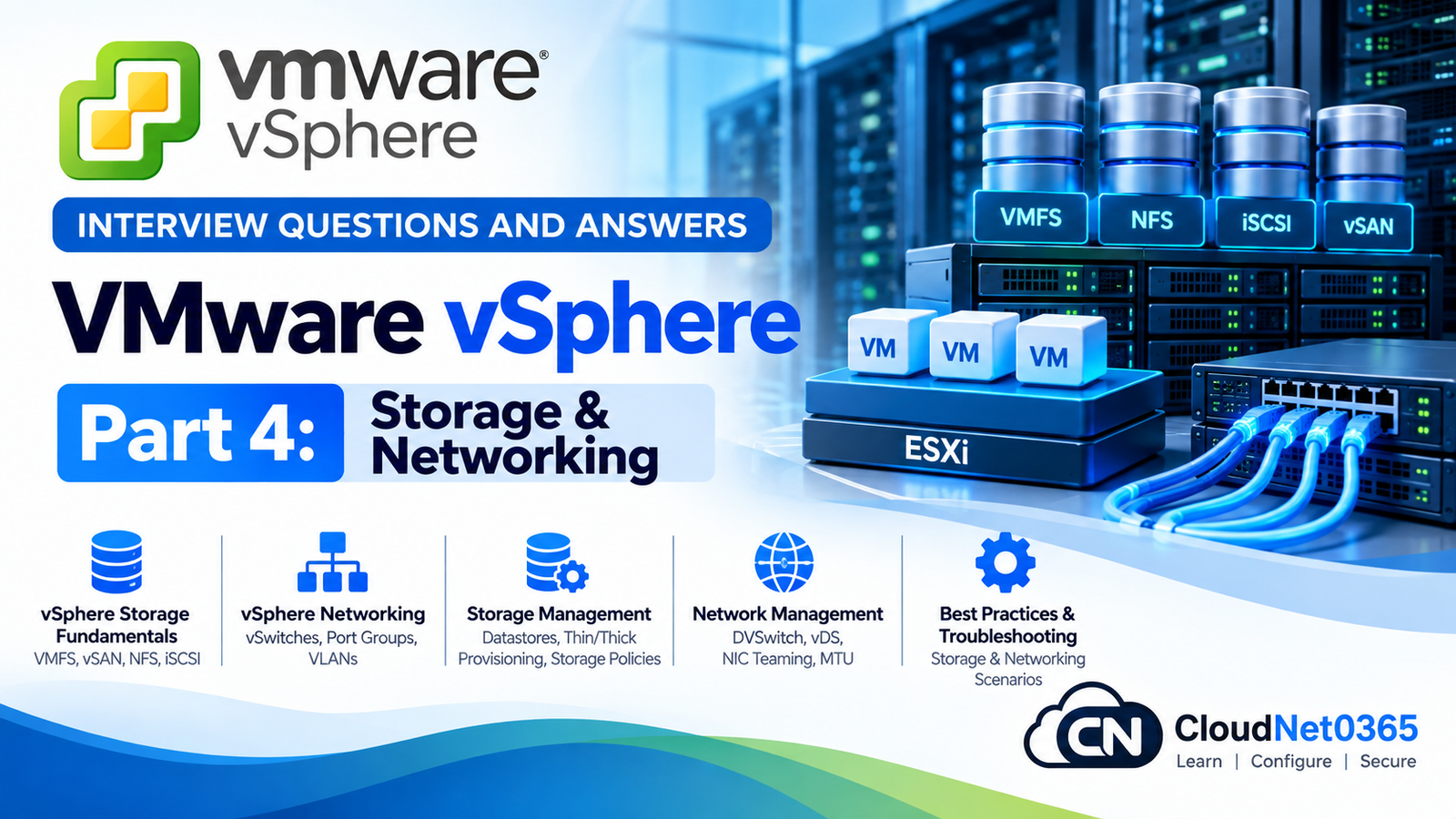
Storage and networking are two of the most important areas in VMware vSphere administration.
A VMware System Administrator should understand not only how to create a datastore or configure a virtual switch, but also how storage protocols, datastores, VMkernel networking, multipathing, VLANs and physical infrastructure work together.
One important distinction is:
- iSCSI, Fibre Channel and NVMe-based technologies are storage protocols or transport technologies used to access storage.
- NFS is a file-based storage protocol used by ESXi to access NFS datastores.
- VMFS is VMware’s file system used primarily on block storage to create VMFS datastores.
- vSAN is a distributed software-defined storage architecture that aggregates local storage resources across ESXi hosts into a vSAN datastore.
- A datastore is the logical storage location presented to ESXi for storing virtual machine files.
For example:
FC/iSCSI/NVMe storage → block device/LUN or namespace → VMFS datastore → VM files
Whereas:
NFS server → NFS datastore → VM files
And:
Local disks across vSAN hosts → vSAN → vSAN datastore → VM files
Understanding these relationships is essential for senior VMware interviews.
VMware vSphere Storage & Networking Interview Questions
Q1. What are the main storage technologies used with VMware vSphere?
VMware vSphere supports several storage technologies, including:
Block storage
Examples include:
- Fibre Channel (FC)
- iSCSI
- FCoE
- NVMe over Fibre Channel
- NVMe over TCP
- Other supported NVMe-based storage technologies depending on the vSphere release and storage hardware
With block storage, ESXi can discover block devices such as LUNs or namespaces and can use supported datastore technologies such as VMFS.
File-based storage
The primary example is:
- NFS
ESXi accesses an NFS export through the NFS protocol and presents it as an NFS datastore.
Software-defined distributed storage
The main VMware example is:
- vSAN
vSAN aggregates eligible local storage devices from ESXi hosts and presents distributed storage to the vSphere environment.
The important interview point is that VMFS, NFS, iSCSI, FC and vSAN are not equivalent categories.
- iSCSI/FC/NVMe technologies → storage access protocols or transports
- NFS → file-based storage protocol
- VMFS → VMware file system
- vSAN → distributed storage architecture
Broadcom’s current documentation lists VMFS with technologies such as FC, iSCSI and NVMe transports, while NFS and vSAN are presented separately.
Q2. What is a datastore in VMware?
A datastore is a logical storage location used by ESXi to store virtual machine files.
A datastore can be backed by different storage technologies, depending on the datastore type.
Examples include:
- VMFS datastore
- NFS datastore
- vSAN datastore
- vVols-based storage
VMware’s API documentation describes a datastore as a storage location for virtual machine files and identifies VMFS volumes and NAS-backed storage among its possible backing technologies.
A datastore can contain:
.vmxconfiguration files.vmdkvirtual disks- snapshot delta files
.nvram- log files
- other VM-related files
Q3. What is VMFS?
VMFS stands for Virtual Machine File System.
It is VMware’s clustered file system designed for VMware virtualization environments.
VMFS allows multiple ESXi hosts to access a shared VMFS datastore when the underlying storage and configuration support shared access.
VMFS is commonly used on block storage such as:
- Fibre Channel
- iSCSI
- supported NVMe-based storage technologies
For example:
SAN → LUN → VMFS → VM files
VMFS should therefore not be described as a storage protocol. It is a VMware file system/datastore format.
Q4. What is VMFS6?
VMFS6 is a version of VMware’s Virtual Machine File System introduced with vSphere 6.5.
Important VMFS6 characteristics include support for modern storage-management capabilities such as automatic space reclamation/UNMAP, subject to the underlying storage system and configuration.
In an interview, a safe answer is:
VMFS6 is the VMFS version introduced with vSphere 6.5 and is used for VMFS datastores in supported vSphere environments. It provides improvements over earlier VMFS versions, including enhanced space reclamation capabilities.
Do not claim that every storage array behaves identically with UNMAP. Storage-array support and configuration matter.
Q5. What is NFS in VMware?
NFS stands for Network File System.
VMware ESXi can use NFS storage to create an NFS datastore.
Unlike a traditional VMFS datastore backed by block storage, an NFS datastore is accessed as file-based network storage.
The ESXi host connects to an NFS server/export through a VMkernel networking path.
For example:
ESXi → VMkernel network → NFS server/export → NFS datastore
Current vSphere documentation supports NFS 3 and NFS 4.1, with capabilities and configuration differing between the versions.
Q6. What is the difference between VMFS and NFS?
| Feature | VMFS | NFS |
|---|---|---|
| Storage model | Block storage with VMFS | File-based storage |
| File system | VMware VMFS | NFS |
| Typical backend | FC, iSCSI, supported NVMe technologies | NAS/NFS server |
| Access | Block device/LUN or supported namespace | Network file export |
| VM datastore | VMFS datastore | NFS datastore |
| Multipathing | Block-storage multipathing mechanisms may apply | Networking and NFS-specific mechanisms |
| VMkernel networking | Depends on storage protocol | Required for network access |
A simple interview explanation is:
VMFS is a VMware file system used primarily on block storage, while NFS provides file-based storage directly through the NFS protocol.
Q7. What is iSCSI?
iSCSI stands for Internet Small Computer Systems Interface.
It transports SCSI commands over IP networks.
In VMware, ESXi can use iSCSI to access block storage from an iSCSI storage array.
The basic flow is:
ESXi iSCSI initiator → IP network → iSCSI target → LUN
The discovered block device can then be formatted as VMFS when appropriate.
Q8. What is an iSCSI initiator and target?
The initiator is the system that initiates the iSCSI connection.
In a VMware environment:
- ESXi acts as the iSCSI initiator.
- The storage array provides the iSCSI target.
The target presents storage resources such as LUNs to authorized initiators.
Q9. What is a LUN?
LUN stands for Logical Unit Number.
In practical VMware/SAN terminology, administrators commonly use “LUN” to refer to a logical block-storage device presented by a storage array.
For example:
Storage array → LUN → ESXi → VMFS datastore
A LUN is not itself a VMFS datastore.
The relationship is:
Storage array LUN → VMFS formatting → VMFS datastore
Q10. What is Fibre Channel in VMware?
Fibre Channel (FC) is a high-speed storage networking technology commonly used for SAN environments.
A typical FC VMware environment contains:
- ESXi host
- FC HBA
- FC switches/fabric
- Storage array
- Storage LUNs
- VMFS datastore
Example:
ESXi HBA → FC fabric → storage array → LUN → VMFS
FC is different from Fibre Channel over Ethernet (FCoE), although both are associated with Fibre Channel storage technology.
Q11. What is an HBA?
HBA stands for Host Bus Adapter.
In traditional Fibre Channel environments, an FC HBA connects the ESXi host to the Fibre Channel fabric.
The HBA provides the interface between the ESXi host and the storage network.
Depending on the storage technology, VMware environments may also use specialized storage adapters or network adapters rather than a traditional FC HBA.
Q12. What is a storage adapter in ESXi?
A storage adapter is an interface through which ESXi accesses storage.
Examples include:
- Fibre Channel HBAs
- iSCSI adapters
- SAS adapters
- NVMe-related devices
- other supported storage adapters
You can inspect storage adapters using:
esxcli storage core adapter list
Q13. What is a storage path?
A storage path is the route between an ESXi host and a storage device.
For example:
ESXi → HBA → FC switch → Storage array → LUN
A storage device may have multiple paths.
Multiple paths provide redundancy and, depending on the configuration, can also improve storage utilization.
You can inspect paths using:
esxcli storage core path list
Q14. What is multipathing?
Multipathing means providing multiple independent paths between an ESXi host and a storage device.
For example:
ESXi
 ├── HBA/NIC → Fabric A → Storage Controller A
 └── HBA/NIC → Fabric B → Storage Controller B
If one path fails, another path may remain available.
Multipathing is therefore primarily used for:
- Redundancy
- Availability
- Path failover
- Potentially improved storage utilization
The exact behavior depends on the storage architecture and path-selection policy.
Q15. What happens if one storage path fails?
If a redundant storage configuration is correctly designed and configured, ESXi can detect the failed path and use an available alternative path.
The result depends on:
- Storage protocol
- Multipathing configuration
- Storage array design
- Path Selection Policy
- Storage vendor configuration
- Whether the remaining paths are healthy
You should never assume that every path failure automatically produces identical behavior.
Q16. What is NMP?
NMP stands for Native Multipathing Plugin.
It is VMware’s native multipathing framework for supported storage devices.
NMP works with storage-specific SATPs and path-selection mechanisms.
In an interview, remember:
NMP → multipathing framework
SATP → Storage Array Type Plugin
PSP → Path Selection Plugin
Q17. What is SATP?
SATP stands for Storage Array Type Plugin.
SATPs are used by VMware’s multipathing architecture to handle storage-array-specific characteristics and path failover behavior.
The exact SATP assigned depends on the storage device and VMware’s supported configuration.
Q18. What is PSP?
PSP stands for Path Selection Plugin.
It determines how ESXi selects among available storage paths.
Examples historically include:
- Fixed
- Most Recently Used (MRU)
- Round Robin
Exact available and supported policies depend on the storage device and vSphere version.
Always follow the storage vendor’s supported configuration rather than selecting a policy solely because it sounds optimal.
Q19. What is Round Robin path selection?
Round Robin is a path-selection policy that can distribute I/O across available paths according to the implementation and configured behavior.
It should not be described as simply “every I/O request goes to the next path.”
The actual behavior depends on VMware’s implementation, device configuration and path-selection settings.
For production storage, follow VMware and storage-vendor recommendations.
Q20. What are Fixed, MRU and Round Robin path-selection policies?
Fixed
Uses a preferred path when available and can fail over to another path when necessary.
MRU
MRU stands for Most Recently Used.
It uses the most recently used path according to the policy behavior.
Round Robin
Uses multiple available paths according to the Round Robin implementation and configuration.
The important interview point is:
Path-selection policy should be selected according to the storage array’s supported VMware configuration.
Q21. What is ALUA?
ALUA stands for Asymmetric Logical Unit Access.
It is a storage-array capability in which different paths to the same storage device can have different access characteristics, such as optimized and non-optimized paths.
ESXi can use storage-awareness mechanisms to identify appropriate paths.
For production environments, the storage vendor’s VMware compatibility and multipathing guidance should be followed.
Q22. What is storage latency?
Storage latency is the time required for a storage I/O operation to complete.
High storage latency can cause:
- Slow VM response
- Application delays
- High guest I/O wait
- Increased VM performance problems
- Timeouts in severe cases
Possible causes include:
- Storage-array overload
- High I/O workload
- Network problems for IP storage
- Failed or degraded paths
- RAID/controller issues
- Oversubscribed storage
- Incorrect storage configuration
Q23. What is IOPS?
IOPS means Input/Output Operations Per Second.
It represents the number of storage I/O operations completed per second.
For example:
A workload performing many small random reads may require high IOPS.
IOPS should not be evaluated alone. You should also consider:
- Latency
- Throughput
- Read/write ratio
- I/O size
- Queue depth
- Workload characteristics
Q24. What is storage throughput?
Storage throughput refers to the amount of data transferred over time.
It is commonly measured in:
- MB/s
- GB/s
A workload can have:
- High IOPS but relatively low throughput
- High throughput but relatively low IOPS
depending on I/O size and workload pattern.
Q25. What can cause high datastore latency?
Possible causes include:
- Storage array overload
- Excessive VM I/O
- Failed storage paths
- Network congestion for IP-based storage
- Storage controller problems
- RAID/degraded-disk conditions
- High queue depth
- Storage fabric problems
- Incorrect multipathing configuration
- Insufficient storage resources
Troubleshooting should begin by determining whether the problem is:
VM → ESXi → storage network/fabric → storage array → underlying disks
rather than immediately blaming the datastore.
Q26. A datastore is accessible from one ESXi host but not another. What would you check?
I would compare the working and affected hosts.
Check:
- Storage adapters
- Storage visibility
- LUN/namespace presentation
- NFS mount configuration if applicable
- VMkernel networking
- VLAN configuration
- Routing
- Storage zoning
- LUN masking
- Multipathing
- Storage rescan results
- ESXi logs
- Storage-array access controls
For NFS, verify that the affected host can reach the NFS server/export through the correct VMkernel networking path.
Broadcom documentation specifically recommends checking VMkernel subnets, routing, VLANs and uplinks when troubleshooting NFS connectivity.
Q27. What is storage zoning?
Storage zoning is a Fibre Channel fabric configuration mechanism used to control which initiators can communicate with which storage targets.
For example:
ESXi HBA → FC Switch → Storage Port
Zoning controls visibility at the FC fabric level.
It is different from LUN masking.
Q28. What is LUN masking?
LUN masking controls which hosts or initiators are allowed to see particular LUNs on a storage array.
A simple distinction is:
- Zoning → controls communication/visibility within the SAN fabric
- LUN masking → controls which hosts can access particular storage LUNs
Both may be used together in a SAN design.
Q29. What is vSAN?
vSAN is VMware’s software-defined distributed storage solution.
It aggregates eligible local storage resources from participating ESXi hosts and presents them as a distributed datastore to the vSphere environment.
Instead of relying entirely on a traditional external SAN/NAS, vSAN uses storage resources within the vSAN cluster.
The exact architecture depends on the vSAN release, including differences between vSAN Original Storage Architecture (OSA) and Express Storage Architecture (ESA).
Therefore, avoid describing every vSAN deployment as having the same disk-group architecture.
Q30. What is a vSAN Storage Policy?
A vSAN Storage Policy defines storage requirements for a virtual machine or its virtual disks.
Depending on the supported vSAN version and configuration, policies can control characteristics such as:
- Availability
- Data placement
- Failure tolerance
- Storage efficiency
- Performance-related requirements
The important point is that vSAN uses policy-based storage management rather than simply assigning a VM to a traditional LUN.
VMware Networking
Q31. What is a vSphere Standard Switch (VSS)?
A vSphere Standard Switch is a virtual switch configured at the ESXi host level.
It provides connectivity between:
- Virtual machines
- VMkernel interfaces
- Physical network adapters
A VSS is configured individually on each ESXi host.
Q32. What is a vSphere Distributed Switch (VDS)?
A vSphere Distributed Switch provides centralized virtual networking management through vCenter Server.
Instead of maintaining separate switch configurations independently on every ESXi host, administrators can manage distributed networking from vCenter.
VDS provides advanced networking capabilities beyond the basic VSS feature set, depending on the vSphere edition and version.
Q33. What is the difference between VSS and VDS?
| Feature | VSS | VDS |
|---|---|---|
| Management | Per ESXi host | Centrally managed through vCenter |
| Configuration consistency | Administrator maintains each host | Centralized |
| Advanced networking | More limited | More advanced features |
| LACP | Not supported on VSS | Supported on supported VDS configurations |
| vCenter dependency | Not required for basic host operation | Required for management/configuration |
A VSS continues to provide basic networking on an ESXi host even if vCenter is temporarily unavailable.
Q34. What is a port group?
A port group is a logical grouping of virtual ports with common networking configuration.
A port group can define settings such as:
- VLAN configuration
- Security policies
- NIC teaming
- Traffic shaping
- Failover behavior
A VM normally connects its virtual NIC to a VM port group.
A VMkernel interface connects to a VMkernel port group.
Q35. What is the difference between a VM port group and a VMkernel port group?
VM port group
Used by virtual machine network adapters.
Example:
VM → vNIC → VM Port Group → vSwitch → Physical NIC → Physical Switch
VMkernel port group
Used by ESXi services such as:
- Management
- vMotion
- IP storage traffic
- vSAN traffic
- Other supported ESXi services
Example:
ESXi Service → VMkernel Adapter → VMkernel Port Group → vSwitch → Physical NIC
Q36. What is a VMkernel adapter?
A VMkernel adapter is a logical network interface on an ESXi host used for ESXi networking services.
Examples include:
- Management
- vMotion
- iSCSI/IP storage traffic
- vSAN
- Other supported VMkernel services
You can inspect VMkernel interfaces using:
esxcli network ip interface list
Q37. What is a VLAN?
VLAN stands for Virtual Local Area Network.
VLANs logically separate network traffic at Layer 2.
For example:
- VLAN 10 → Management
- VLAN 20 → Server network
- VLAN 30 → vMotion
The actual design depends on the organization’s network architecture.
Q38. How do you configure VLANs for VMware networking?
At minimum, you need consistent configuration between:
- VMware virtual switch/port group
- ESXi uplink
- Physical switch
- Physical switch port
- Routing infrastructure where required
For a typical VLAN-backed VM port group:
VM
 ↓
VM Port Group
 ↓
VDS/VSS
 ↓
ESXi uplink
 ↓
Physical switch trunk/access configuration
 ↓
VLAN
The exact configuration depends on whether the physical switch port is configured as an access port, trunk, or another supported design.
Q39. What is VLAN 0 in VMware?
VLAN ID 0 should not simply be described as “the default VLAN.”
Its behavior depends on the virtual switch and physical-network configuration.
For an interview, the safer explanation is:
VLAN 0 is used in specific VLAN-tagging configurations and should not be confused with an ordinary user VLAN such as VLAN 10 or VLAN 20.
Always verify the actual port-group VLAN configuration and physical-switch configuration when troubleshooting VLAN 0 or untagged traffic.
Q40. What is NIC teaming?
NIC teaming means using multiple physical network adapters (uplinks) for a virtual switch or distributed switch.
It can provide:
- Redundancy
- Failover
- Potential traffic distribution
Example:
             ┌── vmnic0 ── Physical Switch A
ESXi vSwitch ┤
             └── vmnic1 ── Physical Switch B
The actual failover and load-distribution behavior depends on the configured teaming policy.
Q41. What are common VMware NIC teaming policies?
Depending on the switch type and vSphere version, common policies include:
- Route based on originating virtual port
- Route based on source MAC hash
- Route based on IP hash
- Route based on physical NIC load
- Explicit failover order
Not every policy is available on every virtual switch type.
The selected policy must also match the physical-switch design.
Q42. What is LACP?
LACP stands for Link Aggregation Control Protocol.
It dynamically negotiates link aggregation between supported network devices.
In VMware vSphere, LACP is associated with supported vSphere Distributed Switch configurations rather than a traditional VSS.
LACP can be used to form a link aggregation relationship with a physical switch when the VMware and physical-switch configuration supports it.
Q43. What is the difference between NIC teaming and LACP?
They are related but not identical.
NIC teaming
A VMware feature for using multiple physical uplinks for redundancy and/or traffic distribution.
LACP
A protocol used to negotiate and maintain link aggregation between network devices.
Therefore:
NIC teaming is broader than LACP. A VMware environment can use NIC teaming without using LACP.
Q44. What is MTU?
MTU stands for Maximum Transmission Unit.
It is the maximum size of an IP packet payload that can normally be transmitted without fragmentation at a particular network layer.
The standard Ethernet MTU commonly used is 1500 bytes.
Larger MTU values are commonly referred to as jumbo frames.
Q45. What are jumbo frames?
Jumbo frames are Ethernet frames configured with an MTU larger than the traditional 1500-byte IP MTU.
They can reduce protocol overhead for certain workloads, but they must be configured consistently across the complete communication path.
For example, if jumbo frames are used for vMotion:
ESXi vmk → vSwitch/VDS → vmnic → Physical Switch → Physical Network → Destination ESXi
The required MTU must be supported consistently along the path.
Do not enable jumbo frames on only one ESXi host and assume the environment is ready.
Q46. What happens if there is an MTU mismatch?
An MTU mismatch can cause:
- Packet loss
- Connectivity problems
- Fragmentation or dropped packets
- vMotion failures
- Storage connectivity problems
- Intermittent network behavior
The exact symptoms depend on the protocol and path.
When troubleshooting, verify MTU configuration end-to-end.
Q47. A VM has no network connectivity. How would you troubleshoot it?
I would troubleshoot from the VM outward.
Step 1 – Check the guest OS
Verify:
- NIC enabled
- IP address
- Subnet mask
- Default gateway
- DNS
- Guest firewall
- Network adapter driver
Step 2 – Check the VM
Verify:
- vNIC connected
- “Connect at power on”
- Correct port group
- Correct virtual network adapter
Step 3 – Check VMware networking
Verify:
- Port group
- VLAN
- VSS/VDS
- Uplink
- NIC teaming
- Physical NIC status
Step 4 – Check physical networking
Verify:
- Switch port
- VLAN/trunk
- STP-related behavior where applicable
- Port errors
- Physical link
- Switch configuration
Step 5 – Test connectivity
Use appropriate tests such as:
ping
tracert
from the guest where applicable.
On ESXi, use tools such as:
esxcli network nic list
esxcli network ip interface list
Q48. A VM loses network connectivity after vMotion. What would you check?
I would compare the source and destination hosts.
Check:
- Destination host has access to the required port group
- Port group exists and is correctly configured
- VLAN configuration is consistent
- VDS membership/configuration is correct
- Physical uplinks are available
- NIC teaming/failover configuration
- Physical switch VLAN/trunk configuration
- Network security settings
- VM’s vNIC connection state
- Destination host networking
If the VM works on the source host but fails immediately after migration, comparing source and destination networking is particularly important.
Q49. A datastore becomes inaccessible. How would you troubleshoot it?
First determine whether the problem affects:
- One VM
- One ESXi host
- Multiple hosts
- The entire cluster
- The storage array
Then check:
ESXi
esxcli storage filesystem list
esxcli storage core device list
esxcli storage core path list
esxcli storage core adapter list
For IP-based storage
Check:
- VMkernel adapter
- VLAN
- IP address
- Routing
- Physical switch connectivity
- Storage target reachability
For example:
esxcli network ip interface list
esxcli network ip route ipv4 list
For VMkernel connectivity testing:
vmkping -I vmkX <destination-ip>
For Fibre Channel
Check:
- HBA status
- Fabric connectivity
- Zoning
- Storage-array ports
- LUN masking
- LUN presentation
- Multipathing
For NFS
Check:
- NFS server availability
- Export availability
- VMkernel connectivity
- VLAN
- Routing
- DNS/name resolution where applicable
- NFS mount state
Do not immediately format or recreate a datastore. First determine why it became inaccessible.
Q50. How would you troubleshoot a production VMware storage or networking incident?
I would use a structured approach instead of making random configuration changes.
Step 1 – Define the scope
Determine:
- One VM?
- Multiple VMs?
- One ESXi host?
- Multiple hosts?
- One datastore?
- Multiple datastores?
- One VLAN?
- Entire cluster?
Step 2 – Identify recent changes
Check whether there was a recent:
- VMware configuration change
- Network change
- Storage change
- Firmware update
- ESXi update
- Switch change
- Storage-array change
- VLAN change
Step 3 – Determine the affected layer
For storage:
VM
 ↓
Virtual disk
 ↓
Datastore
 ↓
ESXi storage stack
 ↓
Multipathing
 ↓
HBA/NIC
 ↓
SAN/IP network
 ↓
Storage array
For networking:
VM
 ↓
vNIC
 ↓
Port Group
 ↓
VSS/VDS
 ↓
vmnic
 ↓
Physical Switch
 ↓
VLAN/Routing
 ↓
Destination
Step 4 – Compare healthy and affected systems
If one ESXi host works and another does not, compare:
- Network configuration
- Storage adapters
- VMkernel interfaces
- VLANs
- Uplinks
- Storage paths
- Multipathing
- Datastore visibility
Step 5 – Check logs and events
Use:
- vCenter Tasks and Events
- ESXi logs
- Storage events
- Network switch logs
- Storage-array logs
Step 6 – Test the lowest-risk hypothesis first
For example:
- Check link status before replacing hardware.
- Check VLAN configuration before changing VM networking.
- Check storage paths before rescanning or changing multipathing.
- Check datastore capacity before changing VM disks.
Step 7 – Avoid destructive actions
Never immediately:
- Reformat a datastore
- Remove a datastore
- Delete VM files
- Change multipathing policies blindly
- Modify storage presentation without understanding the impact
Step 8 – Document the root cause
After restoring service, document:
- What failed
- Why it failed
- What fixed it
- Which systems were affected
- Whether redundancy worked
- Preventive action
This is the approach expected from a senior VMware administrator.
Important VMware Storage & Networking Commands
Storage commands
List datastores/filesystems
esxcli storage filesystem list
List storage devices
esxcli storage core device list
List storage paths
esxcli storage core path list
List storage adapters
esxcli storage core adapter list
VMware Networking Commands
List physical NICs
esxcli network nic list
List VMkernel interfaces
esxcli network ip interface list
Display IPv4 configuration
esxcli network ip interface ipv4 get
Display routing table
esxcli network ip route ipv4 list
Test connectivity through a specific VMkernel interface
vmkping -I vmkX <destination-ip>
Example:
vmkping -I vmk1 192.168.10.20
For NFS and other IP-based storage troubleshooting, Broadcom documentation specifically recommends checking VMkernel interfaces, routes, VLANs and using vmkping with the relevant VMkernel interface.
Useful VM Commands
List registered VMs:
vim-cmd vmsvc/getallvms
Get VM power state:
vim-cmd vmsvc/power.getstate <VMID>
Quick Revision
Storage
- VMFS = VMware File System
- NFS = Network File System / file-based storage
- iSCSI = SCSI over IP
- FC = Fibre Channel storage networking
- LUN = logical block-storage device presented by a storage system
- HBA = Host Bus Adapter
- Multipathing = multiple paths between ESXi and storage
- NMP = Native Multipathing Plugin
- SATP = Storage Array Type Plugin
- PSP = Path Selection Plugin
- ALUA = Asymmetric Logical Unit Access
- vSAN = distributed software-defined storage
Networking
- VSS = vSphere Standard Switch
- VDS = vSphere Distributed Switch
- Port Group = logical group of virtual ports
- VMkernel Adapter = ESXi service network interface
- VLAN = logical Layer 2 network segmentation
- NIC Teaming = multiple physical uplinks for redundancy/distribution
- LACP = Link Aggregation Control Protocol
- MTU = Maximum Transmission Unit
- Jumbo Frames = larger-than-standard Ethernet frames
Exam Answer Summary
If asked to explain VMware storage architecture in an interview, answer:
VMware storage can use block, file-based and software-defined storage technologies. Block storage such as Fibre Channel and iSCSI can provide LUNs or other supported block devices to ESXi, which can be formatted with VMFS to create datastores. NFS provides file-based datastores directly through the NFS protocol. vSAN is a distributed software-defined storage solution that aggregates eligible local storage resources across ESXi hosts.
If asked about storage redundancy:
I would use multiple independent storage paths and verify multipathing, path selection and storage-array compatibility. I would also verify zoning and LUN masking in a SAN environment.
If asked about VMware networking:
I would check the VM, port group, virtual switch, VLAN, VMkernel configuration, physical uplinks and physical switch configuration systematically rather than changing multiple settings at once.
If asked about a storage failure:
I would first establish the scope, then determine whether the problem is at the VM, datastore, ESXi storage stack, path, network/fabric or storage-array layer. I would compare affected and healthy hosts and check paths, adapters, connectivity, events and logs before making changes.
Senior Interview Tip
For senior VMware interviews, don’t answer storage questions by simply listing technologies.
Explain the relationship between the layers.
For example:
VM
 ↓
VMDK
 ↓
Datastore
 ↓
VMFS / NFS / vSAN
 ↓
Storage device or distributed storage
 ↓
Storage protocol / transport
 ↓
Network / SAN fabric
 ↓
Physical storage
Then explain how you would troubleshoot a failure from the VM layer down to the physical infrastructure.
The same principle applies to networking:
VM
 ↓
vNIC
 ↓
Port Group
 ↓
VSS / VDS
 ↓
vmnic
 ↓
Physical Switch
 ↓
VLAN
 ↓
Routing
 ↓
Destination
A senior administrator should be able to identify which layer is failing before changing the configuration.
Final Part 4 Takeaway
The most important distinction to remember is:
VMFS is a file system/datastore format — it is not a storage protocol.
NFS is a file-based storage protocol.
iSCSI and Fibre Channel are storage access technologies/protocols used for block storage.
vSAN is a distributed software-defined storage architecture.
Understanding this distinction prevents one of the most common VMware interview mistakes and gives you a much stronger foundation for troubleshooting real production storage environments.
Next Part
VMware vSphere Interview Questions – Part 5: Performance, Troubleshooting & Real-World Scenarios
The next part will focus on:
- CPU Ready
- CPU contention
- CPU overcommitment
- Memory ballooning
- Memory compression
- ESXi swapping
- NUMA
- Storage latency
- VM performance troubleshooting
- Host performance troubleshooting
- vMotion failures
- HA failures
- DRS issues
- Snapshot problems
- VM power-on failures
- ESXi logs
- vCenter troubleshooting
- Production VMware incidents
- Senior-level troubleshooting methodology