In Part 1, we covered Intune enrollment and device management.
In Part 2, we covered configuration profiles, Settings Catalog, security baselines and policy troubleshooting.
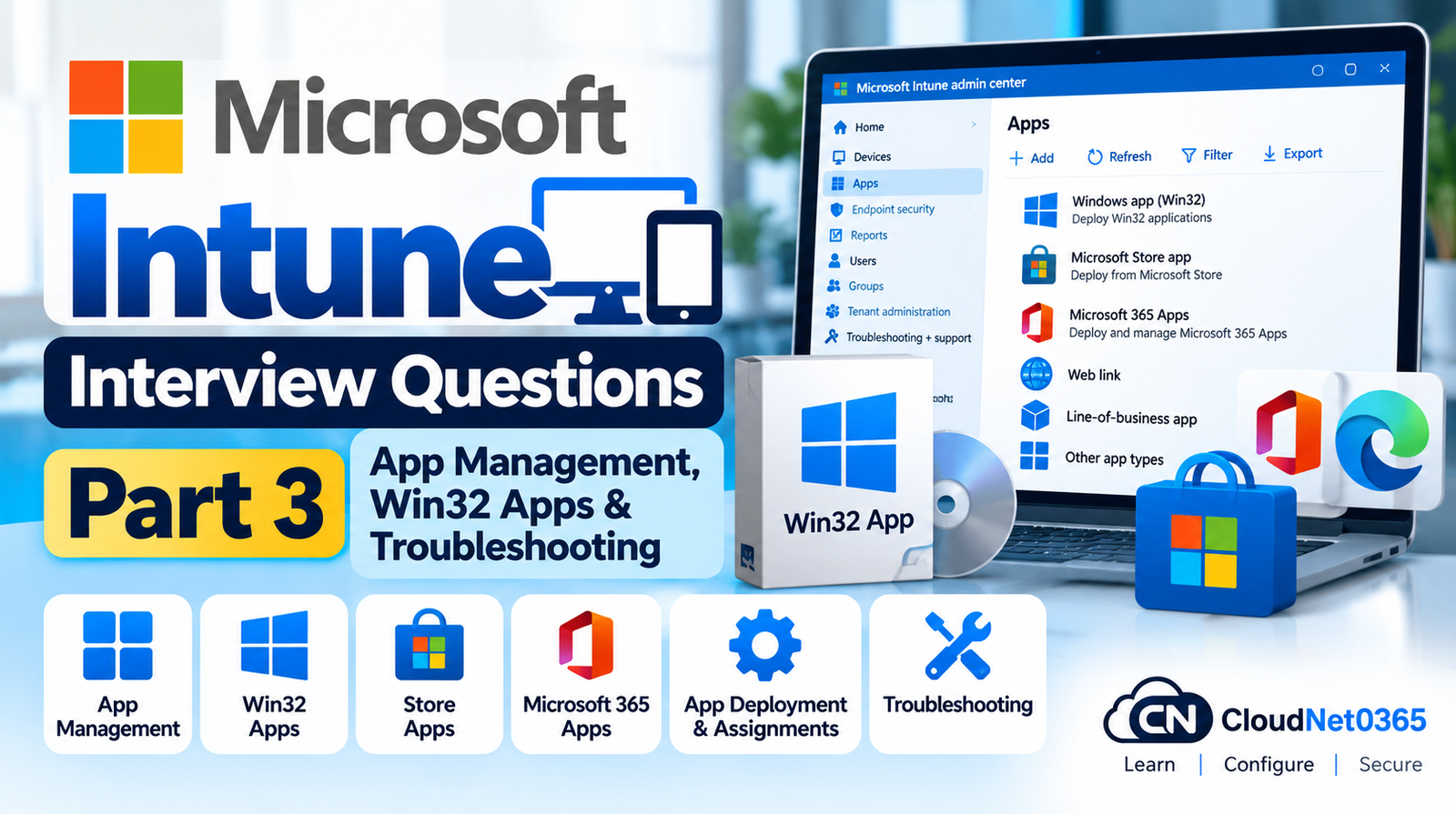
This part focuses exclusively on application management.
A senior Intune administrator should understand:
- Win32 applications
- Microsoft Store applications
- Line-of-business applications
- Required vs Available deployment
- User vs System installation context
- Detection rules
- Requirement rules
- Dependencies
- Supersedence
- Install and uninstall commands
- Return codes
- Application versioning
- Intune Management Extension
- Application troubleshooting
- Autopilot application deployment
- Application replacement
- Real-world deployment failures
The most important concept is this:
Installing an application successfully and detecting that application successfully are two different operations.
Many real-world Intune application problems occur because the installation actually succeeds but the detection rule is incorrect.
Continue the Microsoft Intune Interview Series
← Previous Part: [Part 2: Configuration Profiles, Security Baselines & Troubleshooting] | Complete Series: [Microsoft Intune Interview Questions & Answers – Complete Series] | Next Part →: [Part 4: Compliance, BitLocker, Defender & Conditional Access]
Microsoft Intune Application Management Interview Questions & Answers
1. What application types can you deploy through Microsoft Intune?
Depending on platform and scenario, Intune supports several application types.
For Windows, common types include:
- Win32 applications
- Microsoft Store apps
- Line-of-business applications
- Microsoft 365 Apps
- Web apps
- Windows applications delivered through supported app-management mechanisms
For enterprise Windows management, Win32 applications are particularly important because they provide extensive control over installation, detection, requirements, dependencies and supersedence.
2. What is a Win32 app in Intune?
A Win32 app is a traditional Windows desktop application packaged for deployment through Intune.
Examples:
- Google Chrome
- 7-Zip
- VLC
- Adobe applications
- Custom enterprise applications
- Internally developed applications
The application installer can be:
.exe.msi- Other supported installer content
The application is packaged into an .intunewin file using Microsoft’s Win32 Content Prep Tool.
Microsoft currently supports Win32 app management on supported Windows editions including Pro, Enterprise and Education, with a maximum application package size of 30 GB.
3. Why do we package a Win32 application into an .intunewin file?
The .intunewin package allows Intune to securely upload and distribute the application content.
The basic process is:
Application Installer
        ↓
Win32 Content Prep Tool
        ↓
.intunewin
        ↓
Intune
        ↓
Managed Device
        ↓
Installation
The package contains the application content and associated metadata required for Intune deployment.
4. What is the Microsoft Win32 Content Prep Tool?
The Win32 Content Prep Tool is used to prepare application source files for upload to Intune.
It creates:
Application.intunewin
The administrator then configures:
- Install command
- Uninstall command
- Requirements
- Detection rules
- Dependencies
- Supersedence
- Assignments
The tool does not install the application itself.
It prepares the application content for Intune.
5. What is the difference between Win32 and Line-of-Business apps?
Win32 app
Provides extensive application-management capabilities such as:
- Requirements
- Detection rules
- Dependencies
- Supersedence
- Return codes
- Flexible installation commands
LOB app
Is generally based on an application installation package uploaded directly to Intune.
For Windows MSI-based deployments, Microsoft recommends considering the Win32 application model rather than relying on the older LOB MSI approach, particularly because of deployment interactions during Autopilot.
6. What is a Microsoft Store app in Intune?
The current Microsoft Store app experience allows administrators to browse and deploy applications from the Microsoft Store directly through Intune.
Microsoft’s current Store integration supports:
- UWP applications
- MSIX-packaged applications
- Supported Win32 applications
The current application type is:
Microsoft Store app (new)
7. What is the difference between a Microsoft Store app and a Win32 app?
Microsoft Store app
The application comes from the Microsoft Store catalog and Intune manages its deployment.
Win32 app
The administrator packages and uploads the application content.
Example:
Win32
Installer
 ↓
.intunewin
 ↓
Intune
versus:
Microsoft Store
 ↓
Select application
 ↓
Intune
 ↓
Device
The Store model can reduce packaging work for supported applications.
8. What is a Required application?
A Required application is automatically installed on targeted devices or for targeted users according to the assignment.
Example:
Chrome
 ↓
Required
 ↓
All Corporate Windows Devices
The device should receive the application without the user manually selecting Install in Company Portal.
9. What is an Available application?
An Available application is offered to the user through Company Portal.
The user chooses whether to install it.
Example:
Optional Application
        ↓
Company Portal
        ↓
User selects Install
This is appropriate for optional applications.
10. What is an Uninstall assignment?
An uninstall assignment tells Intune to remove the application from targeted devices/users.
For example:
Application:
Old VPN Client

Assignment:
Uninstall
This is useful during application replacement or migration.
11. What is the difference between Required and Available deployment?
| Required | Available |
|---|---|
| Automatically deployed | User chooses installation |
| Useful for mandatory applications | Useful for optional applications |
| No manual Company Portal installation required | Company Portal normally used |
| Suitable for security agents | Suitable for optional utilities |
12. What is installation context?
Installation context determines whether an application runs in:
- User context
- System/device context
This is extremely important.
User context
The application installs for the user.
System context
The application installs for the device, generally using the system account.
13. Why is installation context important?
Suppose a user-targeted application requires administrative privileges.
If the application is configured incorrectly for user context, the installation can fail.
Microsoft specifically notes that a Win32 app assigned to a user can fail if the application requires device administrator privileges that the standard user doesn’t possess.
Therefore, always determine:
Who is installing?
        ↓
User
   OR
System
before selecting the installation context.
14. When should you use System context?
System context is commonly appropriate for applications that should be installed machine-wide.
Examples:
- Antivirus
- VPN client
- Management agent
- Enterprise browser
- Monitoring agent
- Machine-wide business application
Example:
Corporate Device
      ↓
VPN Client
      ↓
System Context
15. When should you use User context?
User context is appropriate when the application is intended to be installed or configured specifically for the signed-in user.
However, verify the application’s installer behavior before choosing user context.
Not every installer that technically runs under a user account will behave correctly as a user-context Intune deployment.
16. What is a detection rule?
A detection rule tells Intune whether the application is already installed.
This is one of the most important concepts in Win32 application deployment.
Conceptually:
Intune
  ↓
Detection
  ↓
Installed?
 /       \
YES       NO
 |         |
Done      Install
If the detection rule is incorrect, Intune may repeatedly attempt to install an application that is already installed.
17. What detection methods are available for Win32 apps?
Common detection approaches include:
- File
- Folder
- Registry
- MSI product code
- Custom PowerShell script
The correct method depends on how reliably the application can be identified.
Microsoft documents file, registry and PowerShell-based requirement/detection mechanisms for Win32 app management.
18. What makes a good detection rule?
A good detection rule should identify the actual application state reliably.
For example, suppose Chrome installs:
C:\Program Files\Google\Chrome\Application\chrome.exe
You could detect:
- File existence
- File version
- Registry information
- MSI product information where applicable
The rule should distinguish between:
Correct version installed
and:
Old or incomplete installation
where required.
19. What is a detection-rule mistake that can cause repeated installations?
Suppose the application installs successfully but your detection rule checks:
C:\Program Files\App\App.exe
while the actual installation path is:
C:\Program Files (x86)\App\App.exe
Intune may conclude:
Application NOT detected
and try the installation again.
Therefore, always validate the detection rule directly on a test device.
20. What is an MSI detection rule?
For applications installed using MSI technology, Intune can use MSI information to determine whether the application is installed.
This can be useful because MSI provides a standardized product identity.
However, don’t automatically use MSI detection simply because the installer happens to be an MSI.
Choose the detection method that reliably represents the desired application state.
21. What is a requirement rule?
Requirement rules determine whether a device is eligible to install the application.
Examples include:
- Operating system architecture
- Minimum operating system version
- Disk space
- CPU architecture
- File presence
- Registry value
- PowerShell-based requirement
Conceptually:
Device
 ↓
Requirements satisfied?
 ↓
YES → Application eligible
NO  → Application not applicable
22. What is the difference between a requirement rule and a detection rule?
This distinction is frequently asked.
Requirement
Can this application be installed on this device?
Detection
Is this application already installed?
Example:
Requirement:
Windows 11 x64

Detection:
C:\Program Files\App\App.exe exists
23. What happens if a requirement is not satisfied?
The application can be reported as not applicable rather than as a failed installation.
For example:
Requirement:
Windows 11

Device:
Windows 10

Result:
Not Applicable
This is different from:
Requirement satisfied
+
Installer executed
+
Installer failed
which would represent an installation failure.
24. What is an application dependency?
A dependency is another application that must be installed before the primary application.
Example:
Business Application
       ↓
Requires
       ↓
.NET Runtime
Intune can manage Win32 application dependencies.
Microsoft currently documents that Win32 dependencies must themselves be Win32 apps and that dependencies can be configured to install automatically.
25. Give a real-world example of an application dependency.
Suppose you have:
SAP Client
and it requires:
SAP Runtime
You can configure:
SAP Client
   ↓
Dependency
   ↓
SAP Runtime
Intune ensures the required dependency is considered before attempting the dependent application.
26. What happens if a required dependency fails?
The main application may not install.
For example:
.NET Runtime
       ↓
FAILED
       ↓
Business Application
       ↓
Installation not attempted / blocked
Therefore, when an application is stuck in a dependency state, troubleshoot the dependency first.
27. What is supersedence?
Supersedence allows one application to replace another application.
For example:
Chrome v120
      ↓
Superseded by
      ↓
Chrome v140
It is useful for:
- Application upgrades
- Replacing older applications
- Changing application packages
- Migrating to a new application version
28. What is the difference between dependency and supersedence?
Dependency
Application A requires Application B.
A
↓
B
Supersedence
Application B replaces Application A.
Old Version
    ↓
New Version
They solve completely different problems.
29. When would you use supersedence instead of creating a new application?
Use supersedence when the new application/package is logically replacing an existing application.
For example:
VPN Client v5
     ↓
VPN Client v6
Rather than creating an unrelated deployment process, supersedence can express the upgrade relationship.
30. What is an install command?
The install command tells Intune how to execute the application installer.
For example:
setup.exe /quiet /norestart
The exact command depends entirely on the application’s installer.
A good enterprise installer should generally be:
- Silent
- Non-interactive
- Appropriate for the selected context
- Return a meaningful exit code
- Compatible with the target OS
31. What is an uninstall command?
The uninstall command tells Intune how to remove the application.
For example:
setup.exe /uninstall /quiet
or an application-specific uninstall command.
Never assume that the install command can simply be modified to become an uninstall command.
Always verify the vendor’s documented uninstall method.
32. Why are silent installation switches important?
Consider an application that displays:
Click Next
Accept License
Click Install
during deployment.
That is unsuitable for a fully automated Intune deployment.
The installer should normally be capable of running without requiring the user to interact with it.
33. What is a return code?
The installer returns an exit code after execution.
For example:
0 = Success
Other codes may represent:
- Success with restart required
- Failure
- Reboot required
- Application-specific conditions
Intune uses configured return-code handling to determine the result of the installation.
34. Why is return-code configuration important?
Suppose an installer returns:
3010
which commonly indicates that the installation succeeded but a restart is required.
If the return code is not handled appropriately, Intune might report the deployment incorrectly.
Therefore, understand the vendor’s documented return codes before configuring the application.
35. What is a restart-required return code?
A restart-required return code means the application installation completed but Windows needs a restart before the installation is fully effective.
Example:
Installer
   ↓
Success
   ↓
Reboot required
The exact exit code and its meaning must be verified against the specific installer documentation.
Do not assume that every application uses the same return-code definitions.
36. What is application supersedence with uninstall behavior?
During supersedence, Intune can be configured so that the superseding application replaces the older application.
Depending on the configuration, the old application may be uninstalled as part of the replacement process.
For example:
Old VPN
   ↓
Uninstall
   ↓
New VPN
This should be tested carefully because removing the old VPN before the new one is functional could disconnect remote users.
37. How would you upgrade a VPN client on 2,000 remote laptops?
I would not immediately assign an uninstall of the old VPN to all devices.
I would design:
Old VPN
   ↓
Pilot replacement
   ↓
New VPN installed
   ↓
Connectivity validation
   ↓
Old VPN removed
   ↓
Broader deployment
For remote users, I would pay particular attention to:
- Network connectivity
- VPN dependency
- Restart requirements
- Recovery path
- Rollback strategy
- Support availability
38. What is the Intune Management Extension (IME)?
The Intune Management Extension is a Windows component used for capabilities such as Win32 application deployment and PowerShell scripts.
It is installed automatically when a Win32 app or PowerShell script is assigned to a user or device in supported scenarios.
39. Where are the main Intune Management Extension logs?
A key log location is:
C:\ProgramData\Microsoft\IntuneManagementExtension\Logs
Important logs include:
IntuneManagementExtension.log
AppWorkload.log
AppActionProcessor.log
AgentExecutor.log
ClientHealth.log
Microsoft identifies AppWorkload.log as particularly useful for Win32 application deployment activity, while AppActionProcessor.log contains application detection and applicability information.
40. What does AppWorkload.log help you troubleshoot?
AppWorkload.log helps investigate Win32 application deployment activities.
It can provide information about:
- Application processing
- Download
- Installation
- Detection
- Deployment activity
- Errors
When the Intune portal only shows a generic error, the local IME logs can provide much more useful detail.
41. What does AppActionProcessor.log help you troubleshoot?
This log is particularly useful for:
- Detection
- Applicability
- Application action processing
For example, if Intune reports that an application is repeatedly being installed, investigate whether detection is repeatedly returning:
Not detected
even though the application is actually present.
42. A Win32 application installs successfully but Intune still reports “Not Installed.” What do you check?
This is a classic detection problem.
Check:
- Installation actually completed.
- Correct installation path.
- Correct file name.
- File version.
- Registry location.
- MSI product code where applicable.
- Detection rule architecture/context.
- PowerShell detection script.
- Application execution context.
The key question is:
Can Intune correctly detect the installed state?
43. A Win32 application keeps reinstalling every day. What is the likely area of investigation?
The first area I would investigate is detection.
The pattern may be:
Install
 ↓
Success
 ↓
Detection
 ↓
NOT DETECTED
 ↓
Install again
Check the detection rule and compare it against the actual application installation.
44. A Win32 application never starts installing. What should you check?
Check in this order:
- Assignment
- Device/user targeting
- Requirements
- Applicability
- Dependencies
- IME availability
- Device check-in
- Application deadline/start time
- Network connectivity
- Local IME logs
Don’t immediately assume the installer itself is broken.
45. A Win32 application is stuck at “Downloading.” What do you investigate?
Check:
- Device connectivity
- Intune Management Extension
- Available disk space
- Application package size
- IME logs
- Download activity
- Delivery/Content download errors
- Endpoint security/network restrictions
- Whether other applications are downloading successfully
If several applications are stuck downloading on the same device, investigate the common delivery/IME path rather than the individual installer.
46. A Win32 app fails with a generic Intune error code. What should you do?
Don’t rely only on the portal error code.
Use:
Intune
  ↓
Installation details
  ↓
Collect diagnostics where available
  ↓
Device logs
  ↓
IME logs
  ↓
Installer logs
Microsoft provides Win32 app diagnostic collection directly from the Intune admin center for supported scenarios.
47. What logs would you collect for a Win32 application failure?
I would start with:
C:\ProgramData\Microsoft\IntuneManagementExtension\Logs\
Particularly:
IntuneManagementExtension.log
AppWorkload.log
AppActionProcessor.log
Then check:
- Application installer logs
- Windows Event Viewer
- Relevant application-specific logs
- Device Management diagnostic logs
Microsoft currently documents these IME logs as key troubleshooting sources.
48. A Win32 application works manually but fails through Intune. Why?
This is a very common enterprise problem.
Possible differences include:
User vs System context
Manual installation:
User
Intune:
SYSTEM
Working directory
The application may assume a particular working directory.
Environment variables
The SYSTEM account has a different environment.
Permissions
The user may have permissions that SYSTEM does not—or vice versa.
Interactive UI
The installer may expect a user interface.
Network access
The application may require access using the user’s credentials.
Therefore, test the installer using the same context that Intune will use.
49. Why can a Win32 app fail during Autopilot when mixed with LOB apps?
Microsoft currently documents an important deployment consideration: mixing Win32 and LOB app installation during Windows Autopilot enrollment can cause application installation failures because both can use the Trusted Installer service at the same time.
Microsoft recommends considering the Intune Management Extension approach for Win32 deployments; Win32 and LOB apps are supported together in Windows Autopilot device preparation.
This is an important distinction for senior-level interviews.
50. What is the best way to deploy a complex enterprise application?
For a complex application, I would use a structured design:
Application
    ↓
Prerequisites
    ↓
Requirements
    ↓
Dependencies
    ↓
Install command
    ↓
Detection
    ↓
Supersedence
    ↓
Pilot
    ↓
Production
If necessary, use a Win32 app with a PowerShell installer script where supported.
Microsoft currently supports PowerShell scripts as Win32 app installers for scenarios requiring prerequisite checks, configuration changes, conditional logic or post-install validation.
51. How would you deploy an application that requires .NET, Visual C++ Runtime and a configuration file?
I would model the prerequisites explicitly.
For example:
Business App
   |
   +-- .NET Runtime
   |
   +-- Visual C++ Runtime
   |
   +-- Configuration
Where supported, use Win32 application dependencies for prerequisite applications.
The configuration itself can be handled through the application package or appropriate Intune configuration mechanisms.
The goal is to make the deployment deterministic rather than relying on users to manually install prerequisites.
52. How would you replace an old application with a new application?
I would first determine whether the new application is:
- A newer version
- A replacement product
- A completely different application
For a version upgrade:
Old App
 ↓
Supersedence
 ↓
New App
For a product migration:
Old Product
 ↓
Pilot
 ↓
New Product
 ↓
Validation
 ↓
Old Product Removal
The migration strategy should include rollback and user-impact planning.
53. How would you deploy Microsoft Store applications to 5,000 users?
For supported Store applications:
- Search the Microsoft Store catalog from Intune.
- Select the required application.
- Configure application information.
- Select installation context where supported.
- Assign to appropriate groups.
- Choose Required or Available.
- Monitor deployment.
Microsoft’s current Store integration allows administrators to browse and deploy supported Store applications directly from Intune.
54. How are Microsoft Store applications updated?
For supported Microsoft Store applications deployed through the current Store integration, Intune can keep the applications updated as new versions become available.
Microsoft documents automatic updating for Store applications deployed through the current Microsoft Store integration.
This is one advantage over manually packaging every application update.
55. What is a major difference between Microsoft Store Win32 apps and manually packaged Win32 apps?
With a manually packaged Win32 app:
Administrator
 ↓
Downloads installer
 ↓
Packages application
 ↓
Uploads .intunewin
With a supported Microsoft Store Win32 application:
Microsoft Store
 ↓
Select application
 ↓
Intune deployment
The Store integration can simplify application packaging and update management.
However, Store availability, application publisher packaging and supported installation contexts still need to be considered.
56. How would you troubleshoot a Microsoft Store application that doesn’t install?
Check:
- Correct Store application selected
- Assignment
- User/device targeting
- Installation context
- Windows version
- Store/network connectivity
- Application applicability
- Device check-in
- Company Portal where relevant
- Windows application deployment logs
For MSIX-related failures, Windows Event Viewer can provide additional application deployment information.
57. A Company Portal application shows “Available” but the user cannot install it. What do you check?
Check:
Assignment
   ↓
User membership
   ↓
Exclusions
   ↓
Filters
   ↓
Applicability
   ↓
Application requirements
   ↓
Device state
   ↓
Company Portal
Also verify that the application is actually assigned as Available, rather than Required or excluded.
58. A user has the application installed, but Company Portal says it is not installed. What do you investigate?
This can again be a detection problem.
Check:
- Application detection
- Installation context
- Version
- Product identity
- Registry
- File path
- Application inventory
The key is to determine whether the application is installed but incorrectly detected, rather than assuming installation failed.
59. How would you deploy an application to 10,000 devices safely?
Use staged deployment:
Packaging Validation
        ↓
IT Test
        ↓
Pilot – 50 devices
        ↓
Pilot – 500 devices
        ↓
Production – 2,000
        ↓
Production – 10,000
At each stage monitor:
- Installation success
- Detection success
- Application launch
- CPU/memory impact
- User complaints
- Reboots
- Security impact
- Uninstall/rollback
Never treat application deployment as simply:
“Upload → Assign All Users.”
60. Design a complete enterprise application deployment process in Intune.
A mature process should look like:
                 Application Request
                         ↓
                  Security Review
                         ↓
                 License Validation
                         ↓
                  Package Creation
                         ↓
                  Requirement Rules
                         ↓
                   Dependencies
                         ↓
                 Install Command
                         ↓
                  Detection Rules
                         ↓
                 Uninstall Command
                         ↓
                 Return Codes
                         ↓
                   Test Device
                         ↓
                    IT Pilot
                         ↓
                 Business Pilot
                         ↓
                  Production Rollout
                         ↓
                    Monitoring
                         ↓
                  Version Updates
                         ↓
                  Supersedence
                         ↓
                  Retirement
This demonstrates senior-level application-management thinking.
Real-World Application Troubleshooting Scenarios
Scenario 1 — Application installs but keeps reinstalling
Symptoms
Installation = Successful
Detection = Failed
Investigation
Check the detection rule against:
- Actual file path
- File version
- Registry
- MSI product code
- Detection script
Likely root cause
Incorrect detection logic.
Scenario 2 — Application is “Not Applicable”
Check:
- Requirements
- OS version
- Architecture
- Assignment
- Filter
- Applicability
Do not treat this as an installer failure.
Scenario 3 — Application stuck at “Pending”
Check:
- Device check-in
- Assignment
- Requirements
- Dependencies
- IME
- Network
- Application deadline/start time
- Local IME logs
Scenario 4 — Application works manually but fails through Intune
Compare:
Manual Installation
        VS
Intune Installation
Specifically compare:
- User/SYSTEM context
- Permissions
- Environment
- Working directory
- Network access
- Silent switches
- Reboot behavior
Scenario 5 — New application won’t replace old application
Check:
- Supersedence configuration.
- Old application detection.
- New application detection.
- Assignments.
- Uninstall behavior.
- Dependencies.
- Application requirements.
Useful PowerShell Commands
Check whether an application exists
Get-Item "C:\Program Files\App\App.exe"
Check file version
(Get-Item "C:\Program Files\App\App.exe").VersionInfo.FileVersion
Search installed applications through registry
Get-ItemProperty `

"HKLM:\Software\Microsoft\Windows\CurrentVersion\Uninstall\*" |

Where-Object DisplayName |

Select-Object DisplayName, DisplayVersion
For 32-bit applications on 64-bit Windows, also consider:
Get-ItemProperty `

"HKLM:\Software\WOW6432Node\Microsoft\Windows\CurrentVersion\Uninstall\*" |

Where-Object DisplayName |

Select-Object DisplayName, DisplayVersion
Important IME Log Locations
C:\ProgramData\Microsoft\IntuneManagementExtension\Logs
Important files:
IntuneManagementExtension.log
AppWorkload.log
AppActionProcessor.log
AgentExecutor.log
ClientHealth.log
Microsoft currently identifies these logs as important sources for Win32 application and IME troubleshooting.
Quick Revision
| Topic | Key Point |
|---|---|
| Win32 App | Traditional Windows desktop application packaged for Intune |
.intunewin | Packaged Win32 application content |
| Required | Automatically deployed |
| Available | User installs from Company Portal |
| Detection | Determines whether app is installed |
| Requirement | Determines whether device can receive/install app |
| Dependency | Required application prerequisite |
| Supersedence | New application replaces old application |
| User Context | Runs under user context |
| System Context | Runs under system/device context |
| Return Code | Installer result interpreted by Intune |
| IME | Handles Win32 application deployment |
| AppWorkload.log | Win32 deployment activity |
| AppActionProcessor.log | Detection/applicability processing |
| Store App | Application from Microsoft Store integration |
| LOB App | Application uploaded as a line-of-business package |
| Silent Install | Installation without interactive UI |
| Detection Failure | App installed but Intune doesn’t recognize it |
| Requirement Failure | Device isn’t eligible |
| Dependency Failure | Prerequisite application failed/not applicable |
Exam Answer Summary
1. What is a Win32 application?
A traditional Windows application packaged and deployed through Intune using the Intune Management Extension.
2. Detection vs Requirement?
Requirement: Can the application be installed?
Detection: Is the application already installed?
3. Dependency vs Supersedence?
Dependency: Application A requires application B.
Supersedence: Application B replaces application A.
4. Why does an application repeatedly install?
Usually investigate the detection logic first.
5. Why does an application work manually but fail through Intune?
Compare installation context, permissions, environment, silent switches, working directory and network behavior.
6. Where are IME logs?
C:\ProgramData\Microsoft\IntuneManagementExtension\Logs
7. Which log is especially useful for Win32 deployment?
AppWorkload.log
8. Which log helps with detection/applicability?
AppActionProcessor.log
Senior Interview Tip
If an interviewer gives you this scenario:
“The application is installed on the computer, but Intune keeps reporting it as failed and trying to install it again. What would you do?”
A strong answer is:
“I would first distinguish installation failure from detection failure. I would verify the actual installed state locally, then compare the installation path, version, registry information or product identity with the Intune detection rule. I would review AppActionProcessor.log and AppWorkload.log to see how the IME evaluated the application. If the application is genuinely installed but detection returns false, I would correct the detection rule rather than repeatedly reinstalling the application.”
That is the type of reasoning expected from a senior Intune administrator.
Progress
Part 1
Intune Fundamentals, Enrollment & Device Management
Covered:
- MDM/MAM
- Enrollment
- Microsoft Entra Join
- Hybrid Join
- Autopilot
- ESP
- Device ownership
- Co-management
Part 2
Configuration Profiles, Settings Catalog, Security Baselines & Policy Troubleshooting
Covered:
- Settings Catalog
- Security Baselines
- Endpoint Security
- CSP
- OMA-URI
- Assignments
- Filters
- Applicability
- Policy conflicts
Part 3
Application Management, Win32 Apps, Microsoft Store Apps & Troubleshooting
Covered:
- Win32 apps
.intunewin- Store apps
- LOB apps
- Required/Available
- Installation context
- Detection
- Requirements
- Dependencies
- Supersedence
- Return codes
- IME
- Application troubleshooting
Next Part
Continue the Microsoft Intune Interview Series
← Previous Part: [Part 2: Configuration Profiles, Security Baselines & Troubleshooting] | Complete Series: [Microsoft Intune Interview Questions & Answers – Complete Series] | Next Part→: [Part 4: Compliance, BitLocker, Defender & Conditional Access]
Part 4 – Microsoft Intune Compliance, Device Security, BitLocker, Defender & Conditional Access
The next part will move into device security and compliance, without repeating the enrollment, configuration-profile or application-management questions already covered.
It will focus on:
- Compliance policies
- Compliance settings
- Compliance actions
- BitLocker
- Microsoft Defender
- Firewall
- Antivirus
- Attack Surface Reduction
- Security baselines vs endpoint security
- Device risk
- Microsoft Defender integration
- Conditional Access + compliance
- Noncompliant devices
- Encryption reporting
- Security incident scenarios
- Production troubleshooting
Official Microsoft Intune Documentation
For the latest Microsoft Intune documentation, supported capabilities and current configuration guidance, refer to Microsoft Learn.
Microsoft Intune Documentation:
https://learn.microsoft.com/en-us/intune/
Microsoft’s documentation is the authoritative source for current Intune capabilities because enrollment methods, supported platforms, policies and management features can change over time. (Microsoft Learn)