Introduction
A senior Veeam administrator is expected to do much more than create backup jobs.
In production environments, backup failures can involve:
- VMware or Hyper-V infrastructure
- Backup proxies
- Backup repositories
- Storage performance
- Network throughput
- Veeam Data Movers
- Application-aware processing
- VSS
- CBT
- Repository capacity
- Concurrent-task limits
- Backup chains
- Replication
- WAN connectivity
- DNS and authentication
- Hardware failures
- Corrupted backup files
- Production performance impact
The most important skill is therefore finding the actual bottleneck instead of changing random Veeam settings.
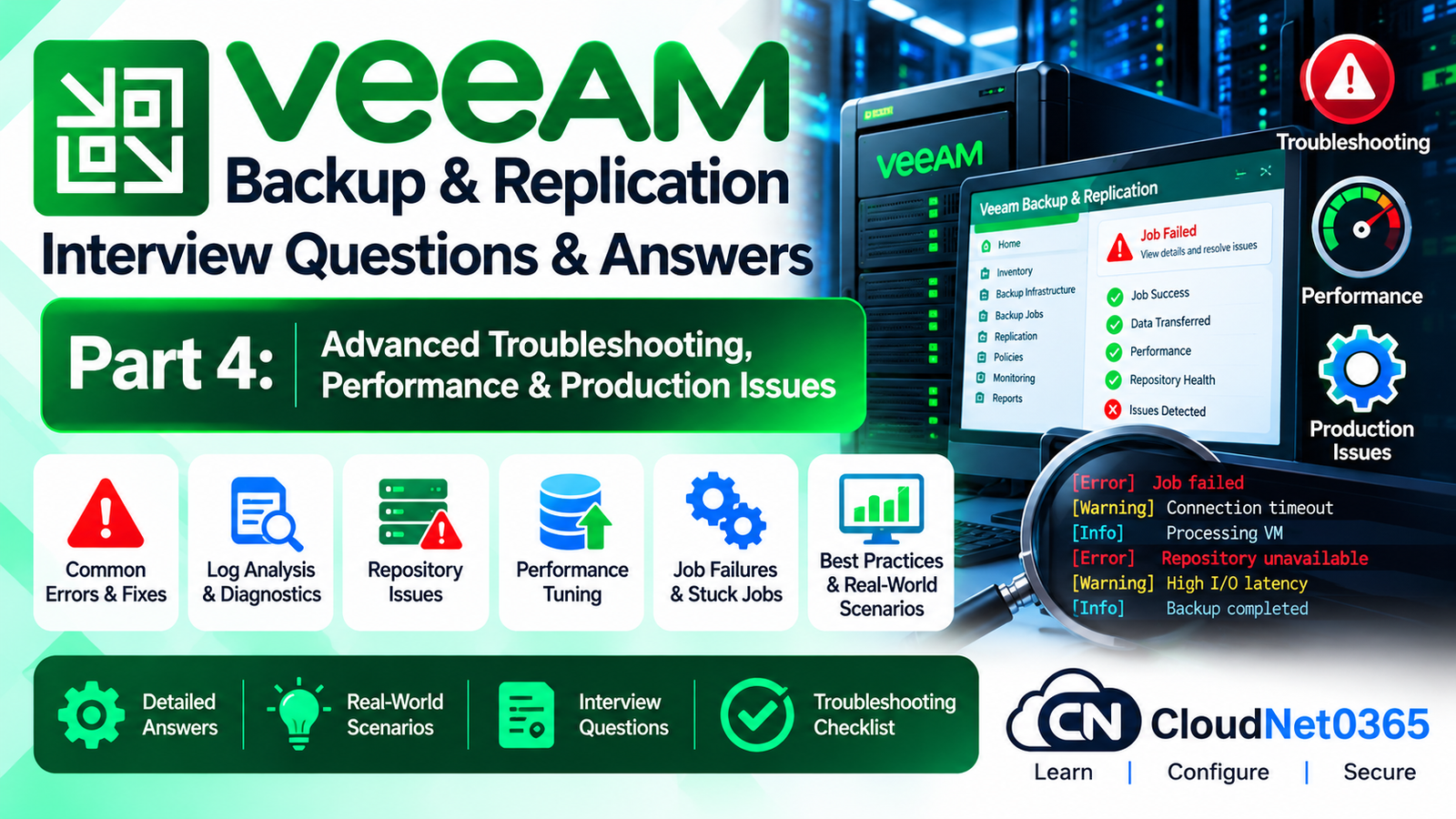
This part focuses on advanced troubleshooting and production scenarios that are commonly discussed in senior Veeam interviews.
1. How does Veeam identify a performance bottleneck?
Veeam analyzes the different stages of the data path.
A simplified backup data flow is:
Source Storage
      ↓
Backup Proxy
      ↓
Network
      ↓
Backup Repository
Veeam evaluates components such as:
- Source
- Proxy
- Network
- Target
- WAN accelerators where applicable
The job statistics can identify which component is limiting the data flow.
A bottleneck does not automatically mean that something is broken.
It indicates the component that is currently limiting the data pipeline.
For example:
Source       20%
Proxy        35%
Network      25%
Target       85%
The repository/target is likely the limiting component.
Veeam’s documentation describes this as analysis of the data pipe, including source reading, proxy processing, network transport and target writing.
2. What are the major stages of Veeam backup data processing?
A simplified processing cycle is:
1. Read data from source
        ↓
2. Process data on proxy
        ↓
3. Transfer data across network
        ↓
4. Write data to target
Veeam processes VM data in cycles rather than simply copying the entire VM as one large operation.
This is why performance troubleshooting must consider the complete data path rather than only the Veeam backup server.
3. A Veeam job is successful but extremely slow. How would you troubleshoot it?
Do not immediately increase the number of concurrent tasks.
First examine:
- Job statistics
- Bottleneck information
- Source storage performance
- Proxy CPU/RAM utilization
- Network throughput
- Repository performance
- Concurrent tasks
- Storage latency
- Compression/deduplication processing
- Backup window
- Antivirus/security software
- Snapshot behavior
The first question should be:
Which component is currently limiting the data path?
4. What does a Source bottleneck mean?
A Source bottleneck means Veeam is spending significant time waiting for data from the source infrastructure.
Possible causes include:
- Slow production storage
- High datastore latency
- Storage contention
- Overloaded ESXi hosts
- SAN performance problems
- NFS latency
- Too many simultaneous backup reads
- Production workloads competing with backup operations
For VMware, investigate:
ESXi host
Datastore
SAN/NFS
Storage latency
VM snapshot activity
Do not assume that Veeam itself is responsible for the slow performance.
5. What does a Proxy bottleneck mean?
A Proxy bottleneck indicates that the backup proxy is spending significant time processing the backup workload.
Possible causes include:
- Insufficient CPU
- Insufficient RAM
- Too many concurrent tasks
- Heavy compression
- Deduplication processing
- Encryption
- Poor proxy placement
- Network limitations on the proxy
A proxy should be sized according to the workload and configured concurrency.
6. What does a Network bottleneck mean?
A Network bottleneck means the processed backup data is waiting to traverse the network.
Possible causes:
- Insufficient bandwidth
- WAN link saturation
- Incorrect routing
- Packet loss
- High latency
- Duplex problems
- Network throttling
- Firewall inspection
- QoS policies
- Congestion
- Incorrect proxy placement
Do not automatically conclude that the physical network is faulty.
Veeam may also report network throttling as a bottleneck when configured traffic limits are being applied.
7. What does a Target bottleneck mean?
A Target bottleneck usually indicates that the repository or destination storage cannot accept processed backup data quickly enough.
Possible causes include:
- Slow disks
- Storage latency
- Deduplication appliance limitations
- RAID performance limitations
- Too many concurrent writes
- Repository CPU limitations
- Insufficient repository resources
- Backup transformations
- Synthetic full processing
- Antivirus scanning backup files
This is especially important when several jobs write to the same repository simultaneously.
8. What is the relationship between concurrent tasks and backup performance?
Veeam can process multiple tasks simultaneously.
Increasing concurrency can improve throughput if the underlying infrastructure has enough capacity.
However, increasing concurrency indefinitely can make performance worse.
For example:
4 concurrent tasks
      ↓
Storage handles workload
      ↓
Good performance
But:
20 concurrent tasks
      ↓
Storage becomes saturated
      ↓
High latency
      ↓
All jobs become slower
Veeam allows concurrent-task limits on backup proxies and repositories specifically to help balance workload and avoid bottlenecks.
9. How do you determine whether a proxy is overloaded?
Check:
- CPU utilization
- RAM usage
- Concurrent tasks
- Network throughput
- Job statistics
- Proxy bottleneck percentage
- Other applications running on the proxy
Also check whether multiple jobs are using the same proxy simultaneously.
A proxy with high CPU and many active tasks may require:
- More resources
- Additional proxies
- Lower concurrency
- Better workload distribution
10. Should you always increase the maximum concurrent tasks?
No.
This is a common senior-interview trap.
More concurrent tasks do not automatically mean better performance.
The limiting resource could be:
- Source storage
- Proxy CPU
- Network
- Repository storage
- Repository CPU
- WAN
- Deduplication appliance
If storage is already saturated, increasing concurrency may make every job slower.
Veeam’s current guidance explicitly states that task limits should be considered together with available CPU, RAM and storage throughput.
11. What is the current Veeam concept of a backup task?
For VMware and Hyper-V workloads, Veeam generally creates a task per VM disk during backup and recovery operations.
For example:
VM1
 ├── C:
 ├── D:
 └── E:
can result in multiple processing tasks.
Therefore, a job containing 50 VMs can generate significantly more infrastructure workload than simply thinking of it as “50 tasks.”
This is important when sizing proxies and repositories.
12. How would you optimize proxy placement?
For VMware environments, place proxies so that they have efficient connectivity to:
- Source hosts/datastores
- Target repositories
- Required network segments
If using direct storage access, ensure the proxy has appropriate access to the required datastores.
Veeam can dynamically distribute workload among multiple available proxies based on connectivity and current load.
13. A VMware backup suddenly becomes much slower than normal. What would you check first?
Compare the current job statistics with previous successful runs.
Check:
Source
Proxy
Network
Target
Then investigate:
Source
- Datastore latency
- ESXi load
- Storage contention
Proxy
- CPU
- RAM
- Task count
Network
- Throughput
- Packet loss
- Firewall
- Routing
Target
- Repository latency
- Free space
- Concurrent jobs
- Storage health
This historical comparison is often faster than changing configuration blindly.
14. What is the impact of too many jobs writing to the same repository?
Too many simultaneous write operations can saturate the repository.
Symptoms may include:
- Slow backups
- Long synthetic operations
- Long merge operations
- High disk latency
- Increasing backup window
- Multiple jobs showing Target bottleneck
Possible solutions:
- Distribute jobs across repositories
- Add repositories
- Increase repository performance
- Adjust concurrent tasks
- Reschedule heavy operations
- Use appropriate storage architecture
15. Why can synthetic full backups cause performance problems?
A synthetic full requires processing existing backup data on the repository rather than reading the entire production VM again.
Depending on the backup chain and storage architecture, this can create significant:
- Read workload
- Write workload
- CPU workload
- Metadata processing
If synthetic operations coincide with production backups, repository performance can degrade.
Therefore, schedule resource-intensive maintenance operations appropriately.
16. Why can backup transformation operations affect repository performance?
Transformations modify existing backup chains.
They can generate substantial storage I/O.
If a repository is already heavily utilized, transformations may compete with:
- Active backup jobs
- Backup copy jobs
- Restore operations
- Health checks
- Other synthetic operations
This can extend the backup window.
17. How do you troubleshoot a repository that is running out of space?
First determine what is consuming the space.
Check:
- Number of restore points
- Retention policy
- Backup chains
- Backup copy data
- Synthetic fulls
- Orphaned files
- Other applications using the volume
- Capacity-tier/object-storage configuration where applicable
Do not manually delete Veeam backup files from the repository simply to create free space.
Use Veeam’s configuration and retention mechanisms whenever possible.
18. What happens when the backup repository becomes full?
Possible effects include:
- Backup jobs fail
- Synthetic operations fail
- Backup copy jobs fail
- New restore points cannot be written
- Retention processing may become constrained
The correct response is to determine why capacity was exhausted and restore sufficient capacity before the next backup window.
19. How would you troubleshoot a Veeam job that fails with a network error?
Use a layered approach.
Step 1
Check DNS resolution.
Step 2
Check basic connectivity.
Step 3
Check required firewall rules.
Step 4
Check routing.
Step 5
Check packet loss and latency.
Step 6
Check Veeam component connectivity.
Step 7
Review Veeam logs.
Step 8
Determine whether the failure is between:
Source ↔ Proxy
Proxy ↔ Repository
Repository ↔ Repository
Proxy ↔ Replica target
Do not simply test connectivity from the Veeam Backup Server because the actual Data Movers may communicate from different infrastructure components.
20. Why is understanding Veeam Data Movers important for troubleshooting?
Veeam uses Data Movers to transport and process backup data.
A simplified architecture is:
Source Data Mover
       ↓
     Network
       ↓
Target Data Mover
The source-side and target-side Data Movers participate in the data pipeline.
Therefore, when troubleshooting a connectivity or performance problem, you must identify which infrastructure components are actually hosting the Data Movers.
Veeam documents the backup data path in terms of source hosts, proxies, repositories, optional guest interaction proxies and gateway servers.
21. What is a gateway server and why can it matter during troubleshooting?
A gateway server acts as an intermediary for certain repository types that cannot host Veeam Data Movers directly.
Examples include:
- Shared folder repositories
- Dell Data Domain deduplicating appliances
- HPE StoreOnce deduplicating appliances
- Object storage repositories
The gateway hosts the target-side Data Mover for these scenarios.
Therefore, if a backup to a deduplication appliance is slow, the gateway server must also be investigated.
22. A backup to HPE StoreOnce is slow. What components would you investigate?
Investigate:
VMware/Hyper-V source
       ↓
Backup Proxy
       ↓
Network
       ↓
Gateway Server
       ↓
StoreOnce
Check:
- Proxy performance
- Gateway CPU/RAM
- Network throughput
- StoreOnce performance
- Concurrent tasks
- Deduplication load
- Repository configuration
- Backup job statistics
Do not investigate only the Veeam server.
23. Why can antivirus software affect Veeam performance?
Security software can scan:
- Backup files
- Temporary files
- Repository files
- Veeam processes
- Proxy working directories
This can introduce significant I/O and CPU overhead.
In production, security exclusions should follow Veeam’s current documented recommendations and the organization’s security policy.
Do not blindly disable antivirus protection.
24. A backup job is stuck at “Processing”. What should you investigate?
“Processing” by itself does not identify the cause.
Check:
- Current task status
- Bottleneck statistics
- Proxy availability
- Repository availability
- Network connectivity
- Snapshot state
- Source datastore
- Concurrent-task limits
- Veeam logs
- Whether another infrastructure operation is blocking progress
Avoid immediately restarting services or rebooting servers.
First identify what component the task is waiting on.
25. How would you troubleshoot a VMware snapshot that remains after a failed Veeam backup?
First determine whether the snapshot is still required by another operation.
Check VMware/vCenter for:
- Snapshot hierarchy
- Snapshot creation time
- Running backup/replication tasks
- Consolidation status
- Datastore space
If a snapshot requires consolidation, investigate the VMware environment carefully.
Do not blindly delete snapshot files directly from the datastore.
Manual datastore-level deletion can cause VM corruption.
26. What can cause VMware snapshot consolidation problems?
Possible causes include:
- Datastore space exhaustion
- Storage latency
- Large snapshot delta files
- Long-running snapshots
- Locked files
- Storage connectivity problems
- Interrupted backup operations
The correct troubleshooting process involves both:
Veeam
+
vCenter/ESXi
+
Datastore/storage
27. What is CBT and why can CBT problems affect backup performance?
CBT means Changed Block Tracking.
It allows Veeam to identify changed blocks since a previous backup instead of reading all blocks of the virtual disk.
If CBT-related information becomes inconsistent, backup behavior can become abnormal.
Possible symptoms include:
- Unexpectedly large incremental backups
- Longer backup duration
- Increased source-storage reads
CBT problems should be investigated using the relevant VMware/Veeam procedures rather than simply disabling CBT permanently.
28. An incremental backup is suddenly almost as large as a full backup. What could cause it?
Possible causes include:
- Large amount of changed data
- Application workload
- Storage activity
- CBT-related issue
- VM disk operations
- Backup configuration changes
Do not immediately assume CBT is broken.
First compare:
Previous incremental size
Current incremental size
VM workload
Changed data
CBT status
If the VM genuinely changed a large percentage of its blocks, a large incremental backup can be completely normal.
29. How would you investigate a sudden increase in backup size?
Compare:
- VM disk size
- Actual changed data
- Previous restore points
- Application workload
- Database activity
- Log files
- VM snapshots
- CBT behavior
- Job configuration
For example, a database VM experiencing heavy data churn may naturally produce much larger incremental backups.
30. What can cause Application-Aware Processing failures?
Possible causes include:
- VSS writer errors
- VSS provider problems
- Guest credentials
- Guest OS issues
- Application-specific problems
- DNS
- Firewall
- RPC/connectivity problems
- Insufficient guest resources
- Services not running
The first step is to determine whether:
Backup itself failed
or:
Backup succeeded but application processing failed
These are different troubleshooting paths.
31. How would you troubleshoot a VSS failure?
On Windows guest systems, investigate:
vssadmin list writers
vssadmin list providers
Look for writers in states other than:
State: [1] Stable
Last error: No error
Also check:
- Windows Event Viewer
- VSS-related errors
- Application logs
- Veeam guest-processing logs
- Available disk space
- VSS providers
Do not restart every VSS-related service without first identifying the failing writer/provider.
32. What is the difference between a backup failure and an application-aware processing failure?
A backup failure means Veeam could not successfully complete the backup operation.
An application-aware processing failure may mean:
- VM data was successfully backed up
- But application processing did not complete successfully
For example, Veeam might successfully create the VM backup but report an error related to Microsoft VSS processing.
This distinction is important when assessing recoverability.
33. How would you troubleshoot a replication job that is falling behind?
Check:
- Source VM change rate
- Replication job frequency
- Proxy performance
- Network throughput
- Target datastore performance
- Target ESXi host
- Concurrent replication tasks
- WAN latency
- Replica disk growth
- Snapshot/restore-point state
The key question is:
Is the environment generating changes faster than the replication infrastructure can transfer and apply them?
34. What is RPO drift in replication?
If the replication target is supposed to be within a specific recovery point objective but increasingly falls behind, there is RPO drift.
For example:
Required RPO: 15 minutes
Actual replication lag: 45 minutes
The replication system is no longer meeting the intended RPO.
Investigate:
- Change rate
- Replication frequency
- Network
- Proxy
- Target storage
- Job duration
35. How would you troubleshoot a replica that cannot power on at the DR site?
Check:
- Replica VM configuration
- Target datastore
- ESXi host
- Network mapping
- Virtual switch/port group
- IP configuration
- DNS
- Resource availability
- VMware permissions
- Replica disks
- Previous failover state
Do not assume that because replication completed successfully, the replica is automatically application-ready.
36. How can you verify that backups are actually recoverable?
Use recovery verification.
Veeam SureBackup can perform recovery verification by starting protected machines in an isolated environment and testing them.
Current Veeam documentation describes two verification approaches:
- Full recoverability testing
- Backup verification and content scanning
This is much stronger than simply checking whether the backup job completed with a Success status.
37. What is SureBackup troubleshooting mode?
If a VM fails verification, Veeam can start the VM in SureBackup troubleshooting mode so the administrator can investigate the problem.
This can help diagnose:
- Application initialization problems
- Network connectivity problems
- Boot timing
- Application timeout settings
The current documentation notes that troubleshooting mode keeps the selected VM/application group powered on until the session is manually stopped.
38. A backup job reports Success. Does that guarantee that the backup is usable?
No.
A successful job means the backup operation completed successfully according to the job’s processing.
It does not replace actual recovery testing.
A mature backup strategy should include:
- Backup integrity checks
- Recovery testing
- Application-aware verification where appropriate
- Restore testing
- DR testing
39. What is a Veeam health check?
A health check verifies the integrity of backup data.
For current Veeam Backup & Replication, health checking can use:
- CRC checks for backup metadata
- Hash checks for VM data blocks
For forward/forever-forward chains, the health check focuses on the latest restore point and may need to read multiple backup files that contribute to that restore point.
40. Does a health check verify every restore point?
No.
For standard backup health checks, Veeam verifies the relevant latest restore point rather than scanning every historical restore point in the chain.
This is an important distinction.
A health check is useful, but it is not equivalent to testing every historical backup.
41. What happens if a health check detects corruption?
The behavior depends on the backup-chain type and repository.
For forward/forever-forward chains, Veeam can detect corruption and initiate the appropriate health-check retry/repair workflow.
For Linux immutable repositories, Veeam documentation notes that repair is not supported; if corruption is detected, the restore point is marked corrupted and an active full may be required for the backup chain.
42. How would you troubleshoot a corrupted backup chain?
Do not immediately delete the chain.
First:
- Identify the affected VM.
- Determine which restore point is affected.
- Run/inspect the health check.
- Check repository/storage health.
- Check whether the corruption is isolated.
- Determine whether another valid restore point exists.
- Consider an active full if required.
- Test restoration afterward.
If the repository itself has underlying storage problems, creating another backup without fixing the storage problem may simply reproduce the issue.
43. What are common causes of backup corruption?
Possible causes include:
- Storage failures
- Disk errors
- RAID/controller problems
- Network interruptions
- Repository filesystem problems
- Hardware failures
- Unexpected power loss
- Software issues
- Underlying storage appliance problems
Repeated corruption should always trigger investigation of the infrastructure underneath Veeam.
44. How do you troubleshoot a Veeam job that suddenly starts failing after months of success?
Use a change-based troubleshooting approach.
Ask:
What changed?
Check:
- Veeam version
- VMware/Hyper-V version
- VM configuration
- Storage
- Network
- Firewall
- Credentials
- Certificates
- Proxy
- Repository
- Retention
- Security software
- OS patches
- Hardware
- DNS
- Time synchronization
A previously stable backup job suddenly failing usually deserves a search for an environmental change rather than random configuration changes.
45. What should you check if all Veeam jobs suddenly fail?
If multiple unrelated jobs fail simultaneously, suspect a shared dependency.
Check:
Veeam Backup Server
       ↓
vCenter / Hyper-V
       ↓
Backup Proxies
       ↓
Network
       ↓
Repository
       ↓
Authentication / DNS
Common shared causes include:
- Repository unavailable
- Veeam service problem
- vCenter unavailable
- Certificate/authentication issue
- Network outage
- DNS failure
- Storage outage
- Repository full
- Infrastructure credentials problem
This is different from one VM-specific failure.
46. What if only one VM’s backup fails while all other VMs succeed?
Focus on VM-specific causes:
- VM snapshot
- VM disk
- CBT
- Guest OS
- VSS
- Application-aware processing
- VM permissions
- VM datastore
- VM configuration
- Disk lock
- Changed-block information
Avoid changing the entire Veeam infrastructure when the evidence points to one VM.
47. How would you troubleshoot a repository that suddenly becomes extremely slow?
Check the repository itself first.
Investigate:
- Disk latency
- IOPS
- Throughput
- CPU
- RAM
- RAID/controller health
- Filesystem
- Free capacity
- Concurrent Veeam tasks
- Synthetic operations
- Backup transformations
- Health checks
- Other applications
- Antivirus scanning
If the repository is an appliance, also check the appliance’s own performance metrics.
48. Why can low free space affect repository performance?
Storage systems can behave differently as capacity becomes heavily utilized.
Low free space can also cause:
- Retention pressure
- Failed synthetic operations
- Failed backups
- Fragmentation depending on storage technology
- Reduced operational flexibility
The exact performance effect depends on the underlying storage system.
Therefore, repository capacity should be monitored proactively rather than waiting for the filesystem to reach 100%.
49. How would you troubleshoot high CPU usage on a Veeam proxy?
Check:
- Number of concurrent tasks
- Compression level
- Deduplication processing
- Encryption
- Other applications
- Proxy hardware
- Job workload
- Multiple jobs using the same proxy
If the proxy is consistently CPU-bound while storage and network are underutilized, adding another proxy or redistributing tasks may help.
50. How would you troubleshoot high CPU usage on a Veeam repository?
Check:
- Concurrent tasks
- Compression/deduplication processing
- Synthetic operations
- Backup transformations
- Repository type
- Other applications
- Security software
- Storage appliance processing
Do not assume that adding CPU will solve a storage I/O bottleneck.
51. How would you troubleshoot high network utilization during backups?
First determine whether the traffic is expected.
Check:
- Number of concurrent jobs
- Backup size
- Changed-data rate
- Proxy placement
- Repository location
- WAN
- Backup copy
- Replication
- Throttling rules
If the network is saturated, possible solutions include:
- Better proxy placement
- Scheduling
- Bandwidth throttling
- Additional links
- Repository placement
- WAN optimization where appropriate
52. What is the difference between network saturation and network packet loss?
Network saturation
The available bandwidth is being consumed.
Symptoms:
- High utilization
- Queuing
- Increased latency
- Reduced throughput
Packet loss
Packets are being dropped.
Symptoms:
- Retransmissions
- Connection instability
- Very poor throughput
- Intermittent failures
A link showing 100% utilization is not necessarily faulty; it may simply be carrying the maximum configured workload.
53. How would you troubleshoot intermittent Veeam failures?
Intermittent failures are often more difficult than consistent failures.
Collect:
- Exact failure times
- Job session logs
- Infrastructure events
- Network events
- Storage events
- VMware/Hyper-V events
- Windows/Linux event logs
- Repository logs
Then correlate timestamps.
For example:
02:15:32 Veeam error
02:15:31 Storage latency spike
02:15:30 Network packet loss
This correlation can reveal the actual root cause.
54. What logs are important when troubleshooting Veeam?
The exact log depends on the operation and component involved.
Useful sources include logs from:
- Veeam Backup Server
- Backup Proxy
- Repository
- Gateway Server
- Guest processing components
- VMware/Hyper-V infrastructure
- Windows/Linux operating system
- Storage appliance
When escalating a problem to Veeam Support, the current documentation recommends exporting the relevant Veeam logs so Support has comprehensive information about the operation.
55. Should you collect only the Veeam Backup Server logs?
No.
This is an important senior-level point.
The backup server may orchestrate the operation, but the actual data path may involve:
ESXi
Proxy
Repository
Gateway
WAN Accelerator
Guest VM
Storage
Therefore, logs from the relevant infrastructure components may be necessary.
56. What information should you collect before opening a Veeam Support case?
Collect:
- Veeam version/build
- Job name
- Exact error message
- Time of failure
- Affected VM
- Repository
- Proxy
- Related infrastructure
- Recent changes
- Job statistics
- Relevant logs
Veeam’s documentation recommends providing comprehensive logs and relevant product/infrastructure information when opening support cases.
57. A backup job fails only during business hours. What would you investigate?
This strongly suggests an environmental contention issue.
Compare:
Business hours
        vs
Backup window
Investigate:
- Production storage load
- Network utilization
- CPU utilization
- Application workload
- Database activity
- Concurrent VMs
- Security scans
- Scheduled tasks
If backups succeed overnight but fail during peak business hours, investigate resource contention before changing Veeam settings.
58. How can production backups affect production VM performance?
Backup operations read data from production storage.
Heavy backup activity can therefore compete with production workloads for:
- Storage I/O
- Network bandwidth
- CPU
- Snapshot resources
This is why backup architecture should be designed to minimize production impact.
Possible improvements include:
- Appropriate proxy placement
- Direct storage access where suitable
- Proper scheduling
- Storage-aware concurrency
- Separate backup networks
- Adequate repository capacity
- Monitoring
59. A production VM becomes slow during backups. How would you investigate?
Compare VM performance:
Before backup
During backup
After backup
Check:
- Datastore latency
- VM snapshot
- ESXi CPU
- Storage IOPS
- Backup concurrency
- Proxy transport mode
- Other simultaneous backup jobs
Then determine whether the performance degradation correlates directly with backup activity.
60. What is a good production troubleshooting methodology for Veeam?
Use this sequence:
1. Identify the exact failure
          ↓
2. Determine affected scope
          ↓
3. Check job statistics
          ↓
4. Identify bottleneck/component
          ↓
5. Check recent changes
          ↓
6. Validate source
          ↓
7. Validate proxy
          ↓
8. Validate network
          ↓
9. Validate repository
          ↓
10. Check logs
          ↓
11. Test corrective action
          ↓
12. Verify backup/recovery
          ↓
13. Document root cause
This is much better than repeatedly restarting Veeam services.
61. Scenario: Backup speed dropped from 300 MB/s to 40 MB/s overnight. What would you investigate?
Start by comparing the job statistics.
Check:
Source
Datastore latency
Storage throughput
ESXi load
Proxy
CPU
RAM
Concurrent tasks
Network
Bandwidth
Packet loss
Latency
Target
Repository latency
Disk utilization
Concurrent writes
Then check:
- Recent changes
- Antivirus
- Storage maintenance
- Network changes
- VMware changes
- Veeam configuration changes
The objective is to identify which component changed.
62. Scenario: Ten backup jobs start simultaneously and all become slow. What is the likely issue?
Look for a shared resource bottleneck.
Potential resources:
- Repository
- Proxy
- Storage
- Network
- Deduplication appliance
Check concurrent tasks and repository/proxy limits.
If all jobs slow down simultaneously, a shared infrastructure bottleneck is more likely than ten independent VM problems.
63. Scenario: Only backups going to the DR repository are slow. Local backups are fast. What would you investigate?
Focus on the DR data path:
Production
   ↓
Proxy
   ↓
WAN
   ↓
DR Repository
Check:
- WAN bandwidth
- Latency
- Packet loss
- Firewall
- WAN acceleration configuration where applicable
- DR repository performance
- DR gateway
- Network routing
This is a classic example of narrowing the investigation to the affected data path.
64. Scenario: Repository performance is good, but Veeam still reports a Target bottleneck. What would you do?
Do not immediately conclude the repository hardware is faulty.
Check:
- Actual storage latency
- Concurrent Veeam tasks
- Repository CPU/RAM
- Backup file operations
- Synthetic operations
- Deduplication processing
- Repository throttling
- Other workloads
Veeam’s bottleneck indicator identifies the weakest point in the data path; it does not by itself prove hardware failure.
65. Scenario: Backups succeed, but restore performance is extremely slow. What would you investigate?
Do not assume backup performance represents restore performance.
Investigate:
- Repository read performance
- Backup storage latency
- Restore target storage
- Network
- Target ESXi/Hyper-V host
- Proxy used during restore
- Number of concurrent restores
- Deduplication appliance behavior
- Restore method
Restore performance should be tested separately.
66. Scenario: A backup repository is healthy, but every backup job is waiting for a task slot. What does this indicate?
This can indicate that the configured maximum concurrent tasks has been reached.
For example:
Maximum tasks = 10

Current tasks = 10
New task = Waiting
The task will wait until an existing task completes.
This is not necessarily an error.
It may be intentional capacity control.
67. Scenario: Increasing repository concurrent tasks makes backups slower. Why?
The repository may already be at its storage-performance limit.
Increasing concurrency can result in:
More tasks
   ↓
More I/O
   ↓
Higher storage latency
   ↓
Lower per-task performance
   ↓
Longer total backup window
The correct setting should be based on actual testing and infrastructure capacity.
68. Scenario: One proxy is overloaded while another proxy is almost idle. What could cause this?
Investigate:
- Proxy connectivity
- Proxy mode
- Datastore access
- Proxy selection settings
- Job-to-proxy mapping
- Proxy availability
- Current task limits
Veeam can distribute workloads across multiple available proxies, but proxy connectivity and configuration affect which proxy can be selected.
69. Scenario: A backup fails after a vCenter migration. What should you check?
Check:
- vCenter registration
- Credentials
- Certificates
- ESXi connectivity
- Proxy connectivity
- Datastore visibility
- VM inventory
- Network connectivity
- Permissions
- Veeam VMware infrastructure configuration
Do not assume the backup job itself is corrupted.
70. Scenario: All Veeam backups fail after a storage migration. What is your approach?
Because the failure affects many jobs, investigate the shared storage path.
Check:
New storage
   ↓
VMware datastore
   ↓
Proxy access
   ↓
Repository
   ↓
Network
Verify:
- Datastore accessibility
- Storage connectivity
- Repository availability
- Permissions
- Multipathing
- Performance
- New network paths
Then test a single controlled backup.
71. Scenario: A backup completes successfully but the restore fails. What does this tell you?
It tells you that:
Backup success and recovery success are not identical concepts.
Investigate:
- Backup integrity
- Restore point consistency
- Repository health
- Restore target
- Permissions
- Target storage
- Network
- Hypervisor
- Application dependencies
This is why recovery verification and actual restore testing are important.
72. Scenario: A SureBackup test fails even though the VM backup is healthy. What would you check?
Check:
- Virtual Lab
- Network mapping
- Application group
- DNS
- DHCP/IP configuration
- Boot timeout
- Application initialization timeout
- VMware permissions
- Required services
SureBackup is testing recoverability and application behavior, not merely whether the backup file exists.
73. Scenario: Backup jobs are consuming excessive WAN bandwidth. How would you control it?
Possible approaches include:
- Network traffic rules/throttling
- Better proxy placement
- Scheduling
- Local repository placement
- Backup Copy architecture
- WAN optimization where appropriate
- Reducing unnecessary simultaneous transfers
Veeam supports network throttling and can report throttling as a performance bottleneck.
74. What is the most common mistake administrators make when troubleshooting Veeam performance?
Changing multiple settings simultaneously.
For example:
Increase proxy CPU
+
Increase concurrent tasks
+
Change compression
+
Change repository
+
Change network
If performance improves, you no longer know which change fixed the issue.
A better approach is:
Measure
↓
Identify bottleneck
↓
Change one relevant variable
↓
Measure again
75. How would you explain Veeam performance troubleshooting in a senior interview?
A strong answer would be:
“I first look at the Veeam job statistics and identify the bottleneck in the data path: source, proxy, network or target. I then validate the corresponding infrastructure component instead of changing settings blindly. For example, a source bottleneck makes me investigate datastore or production-storage latency, while a target bottleneck makes me investigate repository I/O, concurrency and storage performance. I also check recent environmental changes, concurrent tasks, network utilization and logs. After making a targeted change, I compare the job statistics again and verify that the backup and recovery objectives are still being met.”
That demonstrates a methodical production troubleshooting approach.
Important Production Troubleshooting Checklist
When a Veeam backup is slow or failing, work through this checklist:
Source
[ ] VM accessible
[ ] Datastore accessible
[ ] Storage healthy
[ ] Storage latency normal
[ ] ESXi/Hyper-V healthy
[ ] Snapshot state normal
[ ] CBT behavior normal
Proxy
[ ] Proxy available
[ ] CPU sufficient
[ ] RAM sufficient
[ ] Concurrent tasks appropriate
[ ] Correct connectivity
[ ] Correct transport path
Network
[ ] DNS working
[ ] Routing correct
[ ] Firewall rules correct
[ ] Bandwidth sufficient
[ ] Packet loss absent
[ ] Latency acceptable
[ ] No unexpected throttling
Repository
[ ] Repository available
[ ] Enough free space
[ ] Storage latency acceptable
[ ] CPU/RAM sufficient
[ ] Concurrent tasks appropriate
[ ] No storage hardware problems
[ ] No competing workloads
Guest/Application
[ ] VSS healthy
[ ] Guest credentials valid
[ ] Application-aware processing healthy
[ ] Guest network connectivity available
Recovery
[ ] Restore point available
[ ] Health check configured
[ ] Recovery testing performed
[ ] SureBackup configured where appropriate
[ ] Actual restore tests performed
Quick Revision
Veeam performance troubleshooting
Always identify the bottleneck first.
Source → Proxy → Network → Target
Source bottleneck
Usually investigate:
- Production storage
- Datastore
- ESXi/Hyper-V
- Storage latency
Proxy bottleneck
Investigate:
- CPU
- RAM
- Concurrent tasks
- Processing load
Network bottleneck
Investigate:
- Bandwidth
- Latency
- Packet loss
- Routing
- Firewall
- Throttling
Target bottleneck
Investigate:
- Repository storage
- I/O
- Concurrent tasks
- CPU
- Synthetic operations
- Transformations
Intermittent failure
Correlate timestamps across:
- Veeam
- Hypervisor
- Storage
- Network
- Operating system
Backup success
Does not automatically mean:
Recovery has been successfully tested.
Health Check
Checks backup integrity using CRC/hash mechanisms according to the applicable backup-chain and repository workflow.
SureBackup
Used for recovery verification and application-level testing in an isolated environment.
Exam Answer Summary
Q: What is the first step when a Veeam backup is slow?
Identify the bottleneck in the data path.
Q: Should concurrent tasks always be increased?
No. Increasing concurrency can overload the actual limiting resource.
Q: What are the major Veeam performance bottleneck areas?
Source, Proxy, Network and Target.
Q: What does a Target bottleneck usually indicate?
The destination/repository side is limiting the data flow.
Q: What is the purpose of a health check?
To verify backup integrity and help identify corrupted restore points.
Q: Does a successful backup guarantee recoverability?
No. Recovery verification and restore testing are required.
Q: What is SureBackup used for?
Recovery verification and testing of protected machines/applications.
Q: What should you do when multiple unrelated jobs fail simultaneously?
Investigate shared infrastructure components first.
Q: What should you do when only one VM fails?
Focus initially on VM-specific issues rather than changing the entire backup infrastructure.
Q: What is the best troubleshooting method?
Measure → identify bottleneck → make a targeted change → measure again.
Senior Interview Tip
For a senior Veeam interview, avoid saying:
“I will restart the Veeam services.”
Instead, explain how you isolate the failure.
A strong production engineer thinks in terms of:
Scope
  ↓
Data path
  ↓
Bottleneck
  ↓
Infrastructure dependency
  ↓
Root cause
  ↓
Targeted fix
  ↓
Validation
This approach applies not only to Veeam but also to VMware, storage, networking and enterprise infrastructure troubleshooting.
Final Takeaway
The most important Veeam troubleshooting principle is:
Do not troubleshoot Veeam in isolation. Troubleshoot the entire data path.
A Veeam backup job depends on multiple infrastructure components:
Production VM
     ↓
Hypervisor
     ↓
Source Storage
     ↓
Backup Proxy
     ↓
Network
     ↓
Gateway / Data Mover
     ↓
Backup Repository
     ↓
Storage
A failure or performance problem at any point can appear as a Veeam problem.
A senior administrator therefore identifies where the data is waiting, why it is waiting, and which infrastructure component is responsible before making configuration changes.
Next Part
Veeam Backup & Replication Interview Questions and Answers – Part 5: Enterprise Architecture, Security, Capacity Planning, Immutability, Backup Design & Senior-Level Production Scenarios
The next part will focus on enterprise-level Veeam architecture and senior interview scenarios, including backup design, security, ransomware resilience, immutability, capacity planning, repository architecture, DR strategy and production decision-making.