
🧠 Introduction : What is Cisco Express Forwarding (CEF)?
CEF stands for Cisco Express Forwarding. It is a Cisco proprietary method used for forwarding packets in routers and Layer 3 switches.
In traditional routing, whenever a packet arrives, the router performs a lookup process every time, which involves CPU processing. This makes the forwarding slower when traffic increases. CEF is an advanced method that improves this process and ensures that packet forwarding happens much faster and efficiently.
🌐 Basic Example (Understanding the Need for CEF)
Let’s understand this with a simple example:
- User A → IP Address: 192.168.10.1
- User B → IP Address: 192.168.20.1
👉 Both users are on different networks.
When Device A wants to communicate with Device B, it realizes that the destination is on a different subnet. So instead of sending the packet directly, it sends the packet to its default gateway (router).
Now the router checks its routing table:
- If the destination network is present → it forwards the packet through the correct exit interface
👉 This is the normal Layer 3 routing process or a traditional Layer 3 lookup process.
⚙️ Traditional Layer 3 Packet Forwarding/Processing Methods
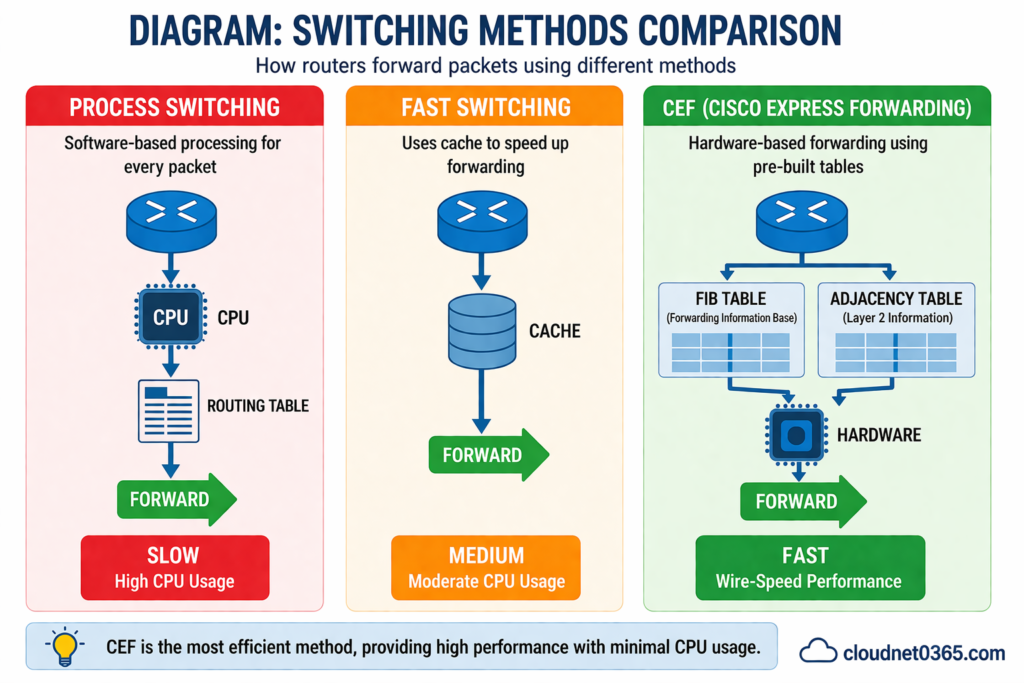
There are three methods of packet forwarding used in routers:
- Process Switching
- Fast Switching
- Cisco Express Forwarding (CEF)
The following comparison helps understand how Cisco Express Forwarding improves performance compared to traditional packet forwarding methods.
| Feature | 🔴 Process Switching | 🟡 Fast Switching | 🟢 CEF |
|---|---|---|---|
| ⚙️ Processing Type | Software-based | Software + Cache | Hardware-based |
| 🚀 Speed | Slow | Medium | Very Fast |
| 🧠 CPU Usage | High | Moderate | Very Low |
| 🔄 Lookup Method | Every packet | First packet only | Pre-built tables |
| 📊 Table Used | Routing Table | Cache | FIB + Adjacency |
| ⚡ Performance | Low | Better | Wire-speed |
| 🔁 Repeated Lookup | Yes | No (after cache) | No |
| 📦 Scalability | Poor | Moderate | Excellent |
🔹 1. Process Switching
In process switching, when a packet enters the router, the router performs a full Layer 3 lookup.
- It checks the destination network
- Finds the next hop IP
- Determines the exit interface
- Then forwards the packet
This process happens every time, even if multiple packets are going to the same destination.
👉 Important point:
- Router CPU is heavily involved
- Each packet is processed individually
- Router performs full Layer 3 lookup every time
- Adds extra overhead
❌ Result:
- Slow performance
- High CPU usage
🔹 2. Fast Switching
Fast switching improves performance compared to process switching.
- First packet is processed normally
- Information is stored in the router’s cache
- Next packets use cached information
👉 This reduces CPU usage compared to process switching.
✔ Result:
- Faster than process switching
- Less CPU overhead
🔹 3. Cisco Express Forwarding (CEF)
Instead of waiting for packets, CEF prepares everything in advance.
- Most advanced method
- Works proactively (before packet arrives)
- Uses hardware-based forwarding
In CEF:
- Routing information is pre-built
- Information is stored in hardware
- Packet forwarding happens at wire speed
👉 Result:
✔ Very fast
✔ Minimal CPU usage
✔ Wire-speed performance/High performance
CEF is the most advanced method of packet forwarding.
🚀 How CEF Works
CEF works using two main components:
- Control Plane
- Data Plane
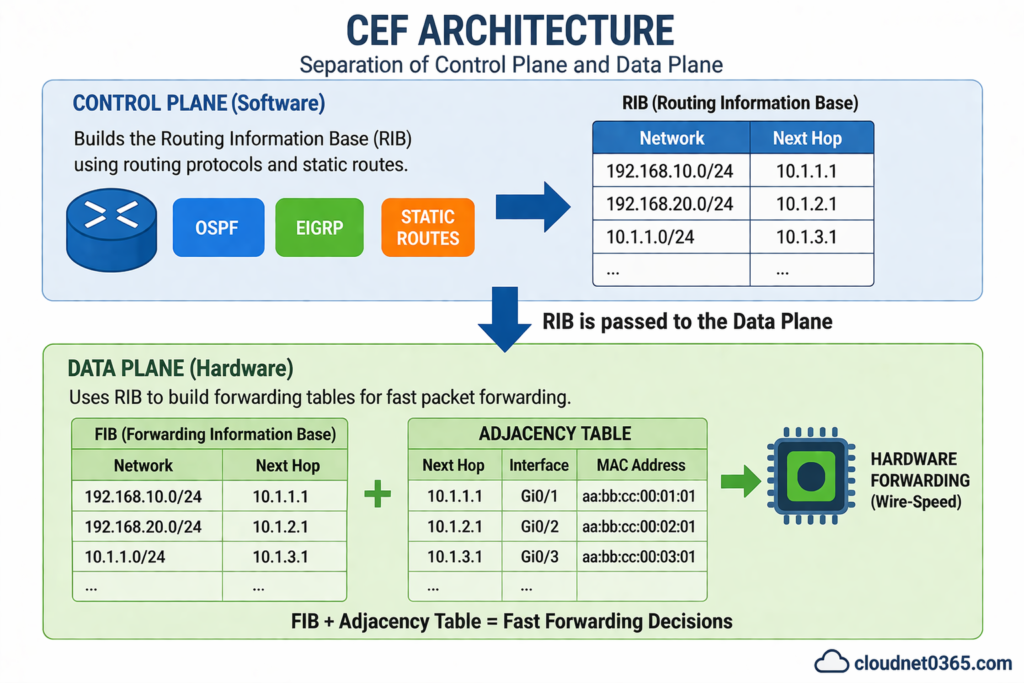
CEF improves performance by separating operations into two planes.This separation helps improve performance and efficiency.
🧩 Control Plane
The control plane is responsible for building the Routing Information Base (RIB).
This is similar to normal routing:
- It collects routing information
- Builds the routing table
- Uses routing protocols like:
- OSPF
- EIGRP
- Static routes
👉 This routing information is then passed to the data plane.
⚡ Data Plane
The data plane is responsible for actual packet forwarding.
Based on the routing information from the control plane, CEF builds two important tables:
1. FIB (Forwarding Information Base)
2. Adjacency Table
📊 1. FIB (Forwarding Information Base)
FIB is a table that contains:
- Destination network
- Next hop IP address
👉 Example:
- Network: 192.168.10.0
- Next hop: 10.1.1.1
Important point:
- FIB is built before any packet arrives
- No need for repeated lookup
🔗 2. Adjacency Table
The adjacency table contains:
- Exit interface
- Layer 2 (MAC address) information
👉 It helps in forwarding packets at Layer 2 level.
🔄 Packet Flow in CEF
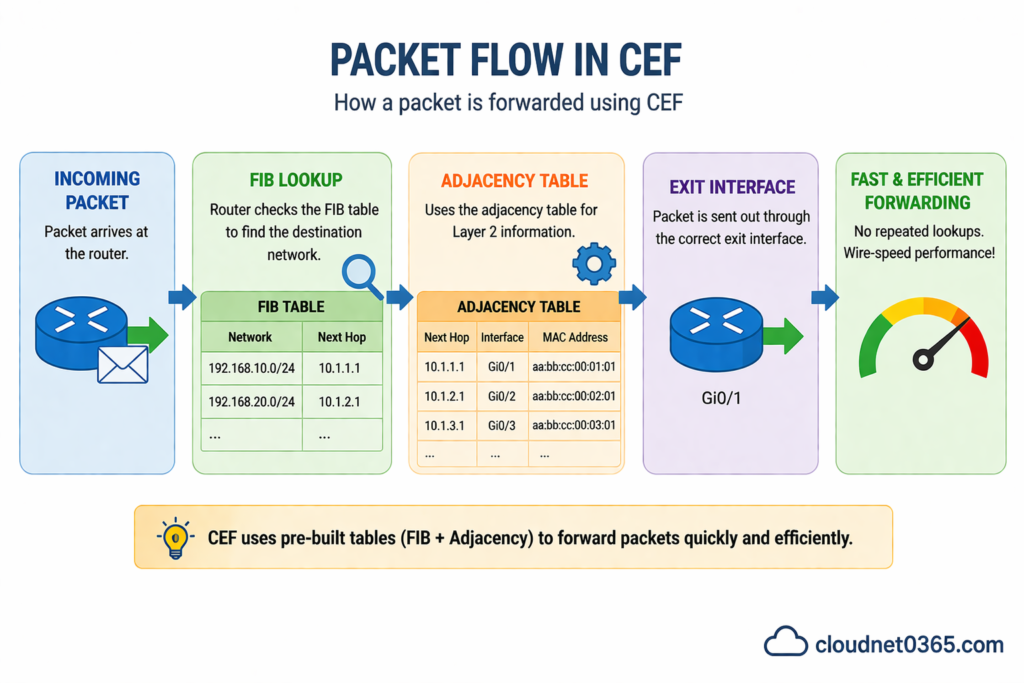
When a packet arrives at the router:
- Router checks the FIB table
- Finds destination network
- Uses Adjacency table for Layer 2 details like MAC and interface
- Sends packet directly out of exit interface
👉 No repeated lookup
👉 No heavy CPU usage
⚡ Why CEF is Fast
CEF provides high performance because:
- Lookup is already done in advance, Pre-built tables (no delay)
- Works at hardware level , so Hardware-based forwarding
- No need for CPU processing for every packet
👉 This results in:
✔ Wire-speed performance
✔ Faster packet forwarding
🧪 Command to Verify CEF
You can check whether CEF is enabled by using:
show ip cef
👉 This command shows:
- Whether CEF is enabled on the router
- Routing entries in FIB
✔ CEF is enabled by default on Cisco devices
🌐 CEF in Real Networks
In real-world networks, CEF plays a very important role.
👉 CEF helps in:
- Enterprise networks
- High-speed routing
- Faster packet forwarding
- Efficient communication between VLANs
- Used in Layer 3 switches for inter-VLAN routing
👉 Even in LAN environments, CEF helps in forwarding traffic efficiently between networks.
🔍 Important Points to Remember
✔ CEF is Cisco proprietary
✔ Uses FIB and Adjacency tables
✔ Works at hardware level
✔ Reduces CPU load
✔ Enabled by default
🧾 Conclusion
Cisco Express Forwarding (CEF) is an advanced and efficient method of packet forwarding that significantly improves network performance. Compared to traditional methods like process and fast switching, CEF provides much better performance by using pre-built tables and hardware-based processing.
Understanding CEF is important not only for exams like CCNA/CCNP but also for real-world networking.
📚 Further Reading
- What is ARP (Address Resolution Protocol)?
- How Switch Learns MAC Address
- Router vs Switch Explained
- CEF – Explained by Cisco
- CEF – Explained by Wikipedia